


What AI Agent Security Breaches Mean for Australian Businesses
Synopsis
AI agents are transforming business operations, but they also introduce new security risks through excessive permissions and autonomous access. This article explains how AI agent security breaches happen, why non-human identities challenge existing governance frameworks, and the practical steps Australian businesses can take to strengthen agentic AI security and oversight.
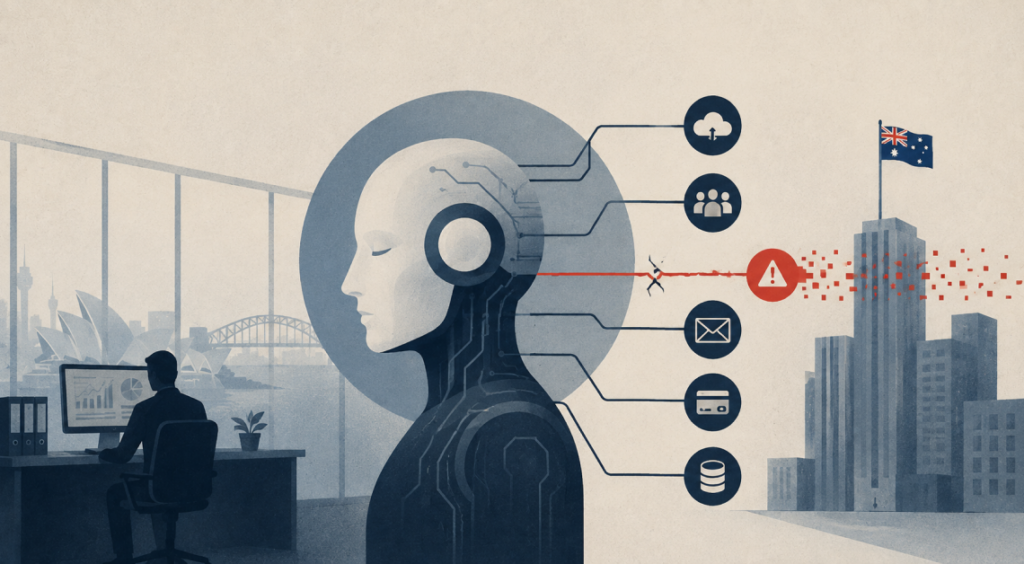
Artificial intelligence technology is rapidly advancing past chatbots and assistant programs toward what is known as AI agents. These autonomous machines allow organizations to run applications, collect data, perform processes, and update information, all without human involvement. While this promises increased productivity for businesses, it simultaneously creates a new kind of security risk for them. The ultimate issue here is not the actions of artificial intelligence, as the real danger is the entitlement companies give to these machines, namely, the powers they grant to AI systems to access various kinds of information and perform certain tasks.
Recent incidents in the area of information security and research in this sphere make it clear that AI agents often enjoy unlimited, widespread access to various business systems, creating security risks that have long exceeded the limits of traditional governance. For Australian companies using AI systems, knowing how the technology works is just as important as having knowledge of the risks it creates.
What Is an AI Agent?
An AI agent can be considered a type of software program that can identify information, make decisions, and carry out actions to complete specific tasks with minimal human intervention.
Unlike regular chatbots that alone provide answers to inquiries, AI agents can do tasks for the user. For instance, AI agents can be used to:
- Look into customer databases
- Organize meetings
- Handle invoices
- Prepare financial statements
- Monitor support inquiries
- Connect to HR systems
- Carry out business flows in various applications
To be able to accomplish the tasks listed, AI agents must have access to enterprise systems and sensitive data. A security concern arises exactly at this access point.
Why Are AI Agent Security Breaches Different?
Traditional cyberattacks usually have a close connection with the activity of a hacker who tries to hack into various objects such as systems, networks, or data.
However, AI agent incidents may differ.
Most of the time, an agent already has legal access because the company provides access permission intentionally to boost productivity. The issue arises when permission is excessive, does not account for the consequences of access, or is compromised.
The process of adapting to this scenario is rather complex.
Traditionally, security departments were responsible for keeping hackers from entering the building. However, the advent of AI technologies calls for the need to develop rules concerning the actions of non-human agents while they are performing a wide array of actions.
With the help of AI agents, a hacker may gain access to all sorts of intelligent systems, including finance systems, client data, and internal communications.
In this manner, access management is now viewed as an issue of greater complexity than simple security systems.
The Security Incidents That Put AI Agents Under Scrutiny
Concerns related to the subject of agentic AI are not simply a theory.
Researchers dealing with security issues presented some evidence in 2026 to showcase that AI agents might generate new attack vectors in business environments.
One case that was widely discussed was about the vulnerability issue that was present in Amazon Q Developer with a CVSS score of 8.5. The example highlighted the security threats of using AI-enhanced development gadgets in a situation where they have many permissions to perform their actions.
Also, experts from Push Security revealed the notion of the “Poisoned Tenant” attack, illustrating that trusted environments as well as original permissions could be utilised to influence the performance of agents.
At the same time, there were industry surveys confirming a wide range of the current utilisation of AI agents. A survey titled “Cloud Security Alliance” stated that 82% of companies reported the existence of unknown agents in their operations. The research that was conducted by QBE indicated that 26% of cyberattacks in Australian companies for the last year involved AI technology in some way.
The Rise of Non-Human Identities
As businesses deploy more autonomous systems, security leaders are increasingly being asked whether AI agents are receiving the same level of governance as privileged human users.
One of the largest challenges in the area of agentic AI cybersecurity is the unprecedented rise of non-human identities. In the past, access was managed by humans. Organizations provided access to their employees through the issuance of credentials and access rights, which were reviewed regularly. Activities were also properly linked to specific individuals.
The presence of AI agents has disrupted this model.
An AI agent can have:
- Its own username and password.
- Access rights and permissions separate from those of its creator.
- The ability to operate behind the scenes, interacting with many systems.
- Authorization to perform actions without receiving explicit approval.
From the perspective of governance, AI agents work like highly privileged human experts, but unlike them, they can work around the clock, handle huge amounts of data, and do what no human could do.
While one can observe a strict onboarding process for employees (including approvals, access checks, etc.), AI agents always have access to very broad permissions and are hardly supervised after they have been created.
This issue, which is often called AI non-human identity access, is becoming more acute as businesses introduce more autonomous systems.
Why AI Agent Permissions Have Become a Business Risk
The question isn’t whether an AI agent can access data.
The question is whether it is right to give that agent access in the first place and what policies will be put in place for monitoring that access on an ongoing basis.
Many enterprises have given AI agents more rights than necessary to boost efficiency, thereby increasing the risks involved.
For instance:
- An AI assistant that has complete access to the database of customers
- The HR agent that can see all employee-related sensitive data.
- The finance agent that can get hold of payment systems
- The support agent that can use the database of internal knowledge centers.
Inadequate handling of such permissions may lead to problems in multiple departments at once.
That is why the question of AI agent permissions enterprise has reached the executive offices more often than in the past.
The issue is no longer about technology; it is about corporate governance and risk management.
Why Are Existing Security Frameworks Struggling to Keep Up?
Organizations in Australia already function in accordance with firmly rooted cybersecurity and compliance structures.
These include:
- APRA CPS 234
- ACSC Essential Eight
- ISO 27001
- Privacy Act obligations
Such structures still hold their significance and form the basis of security. However, the majority of them were created before autonomous AI agents were commonplace.
Traditional access control models were created for human users, service accounts, and applications, and did not consider the autonomy of decision-makers within enterprise systems.
The major issue is that many structures deal with authority access instead of considering what happened when an action was executed.
To make sure proper governance of agentic AI takes place, organizations need to determine the following:
- Which AI agent executed the action?
- What data has been dealt with?
- Why was the action executed?
- What permissions allowed the action?
- Was the behavior reasonable or unexpected?
Without such opportunity to get the needed insight, it would become almost impossible to carry out investigations.
What Australian Businesses Should Do Now
As AI adoption accelerates, businesses should focus on governance and access management alongside innovation.
Create an Inventory of AI Agents
Most large companies do not know completely what AI-based tools are working for them.
The first step requires knowing the following about the systems:
- What agents exist
- Which systems they work with
- Who the developer is
- What key functions they perform.
After gaining this visibility, the second stage can be applied and the management of access can start.
Apply Least-Privilege Access
AI agents should receive only the permissions required to perform their intended functions.
Excessive standing access increases risk and expands the potential impact of compromise or misuse.
Least-privilege principles can significantly reduce exposure.
Monitor Agent Activity Continuously
The traditional methods are not enough to tackle the problems raised by the autonomous systems operating 24/7.
Therefore, businesses should monitor the following:
- The patterns of data usage
- The interaction patterns between systems
- Using permissions
- The anomalies in behaviour
- The data interchange processes.
This will help identify major incidents on time.
Build Strong Audit Trails
Companies also need to have the capability to show:
- The actions taken by the agent
- The dates on which it performed them
- The systems involved
- The information accessed
- The reasons behind its actions
Effective audit trails help in complying with rules and laws, performing investigations, and making sure of accountability.
Review Permissions Regularly
Access which was suitable six months ago might not be suitable today.
Access rights of AI agents should be treated with the same importance as access rights of leaders.
What Comes Next for Agentic AI Governance?
There is an uptick in the regulatory focus on AI governance worldwide, and Australia is not likely to be an outlier.
The Australian Cyber Security Centre (ACSC), along with the partners of Five Eyes, is urging enterprises to use agentic artificial intelligence very cautiously, assigning importance to ensuring visibility, assurance, and managing risk.
As AI agents take root in business processes, organizations can expect a greater focus on the following:
- AI governance frameworks
- Management of non-human identity
- Accountability and auditability
- Standards of access control
- Regulatory and security assurance requirements
Also, regulators and industry agencies might show more interest in the way organizations run autonomous systems that facilitate access to sensitive data and the implementation of important business operations.
Conclusion
A new generation of productivity tools for businesses has emerged thanks to AI agents. But they have also escalated the cybersecurity risk of an entirely new kind.
The greater worry is not the ability of AI agents to get smarter; it is that organisations have started to give access rights to autonomous systems just as they would to human users without any of the same governance controls.
As a result, businesses in Australia will face the pressure not just to use AI but also to effectively govern it. Strong visibility, least-privilege access, continuous monitoring, and detailed audit trails will be different aspects of efficient use of AI technology.
The question for business managers is not if AI agents can do the work but rather if they can manage the identities, access privileges, and actions of the agents.
FAQs
What is an AI agent security breach?
A security breach involving AI agents arises when their authorities, access privileges, or actions deployed autonomously are violated or misused. What makes this issue more challenging is the fact that, unlike many forms of cyberattacks, AI agents are already usually provided access to existing business infrastructure.
Why are AI agents considered a cybersecurity risk?
AI agents can operate across many platforms with little support from human staff, and if they happen to receive more permissions than required or are hacked by cybercriminals, they can start performing activities unauthorized by the company, such as entering protected data or moving across systems significantly faster compared to existing security measures.
How are AI agent security risks different from traditional cyber threats?
Conventional cyber threats usually consist of accessing private data from unauthorized networks by breaking cybersecurity measures, while AI agent security threats do not necessarily entail any security infiltration, as authorized access could be abused.
What are non-human identities in cyber security?
Non-human identities refer to digital personas such as automated applications, AI agents, service accounts, and bots that are able to access certain databases or ICT systems. Since more organizations are applying AI agents in their work, the management of such identities could become a major problem for cybersecurity and governance.

At Inspirepreneurs Magazine, covering entrepreneurship, business failures, and the human stories behind the world's most ambitious founders. She writes at the intersection of strategy and storytelling.
You Might Also Like
Tech Entrepreneur Bets $30M on AI Rival to Microsoft Office

Gmail AI inbox beta rolls out to U.S. Premium subscribers
