


Pro Medicus: How a Melbourne Startup Built a Global Healthcare Technology Business
Synopsis
From a Melbourne-based startup founded by a doctor and a technology specialist to a global healthcare technology company, the Pro Medicus story offers valuable lessons in innovation, specialised expertise and long-term growth.
Healthcare has never had a shortage of data. What it has often struggled with is turning that data into something doctors can access quickly, reliably and at large scale. Medical imaging makes this challenge particularly clear. A single CT or MRI examination can generate hundreds of images and as imaging technology has advanced, hospitals have had to find better ways to store, retrieve, process and share them without slowing down the people responsible for interpreting them.
This is where Pro Medicus enters the story. Founded in Melbourne in 1983 by Dr Sam Hupert and technology specialist Anthony Hall, Pro Medicus was initially driven by the application of software to practical problems in healthcare settings. Four decades later, that small Australian venture has evolved into a global healthcare informatics company whose Visage 7 platform is used to manage and view medical imaging at major healthcare organisations. Pro Medicus now operates from Melbourne, Berlin and San Diego, with its technology serving hospitals, imaging centres and healthcare groups worldwide.
But the interesting part of the Pro Medicus story is not simply that two Australians founded a healthcare technology company in the early 1980s. It is how the company kept moving towards increasingly difficult problems in medical imaging, eventually turning speed, scalability and workflow efficiency into a competitive advantage.
Before Pro Medicus, Healthcare Was Still Entering the Digital Age
When Pro Medicus was founded in 1983, computers were only beginning to find their place in healthcare. Medical imaging was largely moving through an analogue environment. Radiology departments depended heavily on physical films while the concept of digitally storing and communicating medical images was still developing. Picture Archiving and Communication Systems, commonly known as PACS, emerged as an important part of this transition.
The industry has changed dramatically since then. Digital imaging has become standard, imaging volumes have expanded and healthcare organisations now need enterprise-wide systems capable of managing enormous quantities of information.
Yet digitalisation introduced a different problem. Storing images was no longer enough. Doctors needed fast access to them while hospitals needed systems that could work across departments, locations and different types of imaging equipment. That problem continues today.
The global PACS market was estimated at US$4.83 billion in 2026, up from US$4.43 billion in 2025, according to The Business Research Company. It is projected to reach US$6.76 billion by 2030. The market is being driven by increasing digital imaging volumes, demand for workflow efficiency, cloud adoption, remote access and AI-assisted imaging.
Two Founders with Two Different Strengths
The origins of Pro Medicus can be traced to the meeting of two people with very different backgrounds.
Dr Sam Hupert was a medical doctor who graduated from Monash University Medical School and began practising medicine in 1980. Anthony Hall brought a technology and science background to the partnership and would eventually become the principal architect behind much of the company's software development. He was a graduate of La Trobe University, and was the main architect and developer of the firm’s core software systems.
The two met at a wine-tasting event. Their shared interest in using computers to improve healthcare eventually developed into a business idea. That partnership proved important because Pro Medicus was built around the combination of clinical understanding and technical expertise.
The company initially focused on medical billing and administrative software. Hupert continued to practice medicine for some time before leaving general practice in late 1984 to devote himself full-time to Pro Medicus. It was a small beginning but the founders had identified something that would become increasingly valuable. They found that healthcare professionals had problems that software could solve.
From Administration to Medical Imaging
Pro Medicus did not immediately become the global imaging company it is today. The business spent its early years developing healthcare software and gradually expanded its capabilities. Its direction changed as digital radiology began becoming more important.
One of Pro Medicus' key initiatives on the international scene was in 2004, when it signed a three year, $10 million deal with Agfa Corporation in the US to target the North American imaging centre market. The deal gave the Australian company an important foothold in the North American healthcare market.
But the more transformative move came five years later.
On 28 January 2009, Pro Medicus acquired the Visage Imaging Group, a US and Germany-based medical imaging technology company which develops digital imaging and advanced visualisation technologies. The acquisition marked a key step in Pro Medicus' international growth strategy. It transformed the company into a global provider of medical imaging solutions and created the foundation for the Visage 7 platform that drives much of its business today.
Pro Medicus' Transformation
| Period | Major Development | Why It Mattered |
| 1983 | Pro Medicus founded in Melbourne | Entered healthcare software |
| 1984 | Sam Hupert moved full-time into the business | Founding team committed to building the company |
| 2000 | Pro Medicus listed on the ASX | Entered public markets |
| 2004 | A$10 million Agfa North America agreement | Strengthened North American presence |
| 2009 | Acquired Visage Imaging | Created foundation for global imaging strategy |
| 2020s | Visage 7 expanded across major healthcare organisations | Established enterprise imaging as core growth engine |
| 2026 | 10 new contracts, Minimum A$407 million | Demonstrated continued demand for its technology |
Solving a Bigger Problem with Visage 7
The medical imaging industry did not simply need more storage. It needed better ways to access and manage increasingly complex imaging data. This is where Pro Medicus developed a distinct advantage.
Visage 7 utilizes server-based computing and adaptive streaming to provide medical images to the users without transferring the whole DICOM payload to the user devices. As stated by Pro Medicus, only the necessary pixels are sent via adaptive streaming to the user devices in Visage 7.
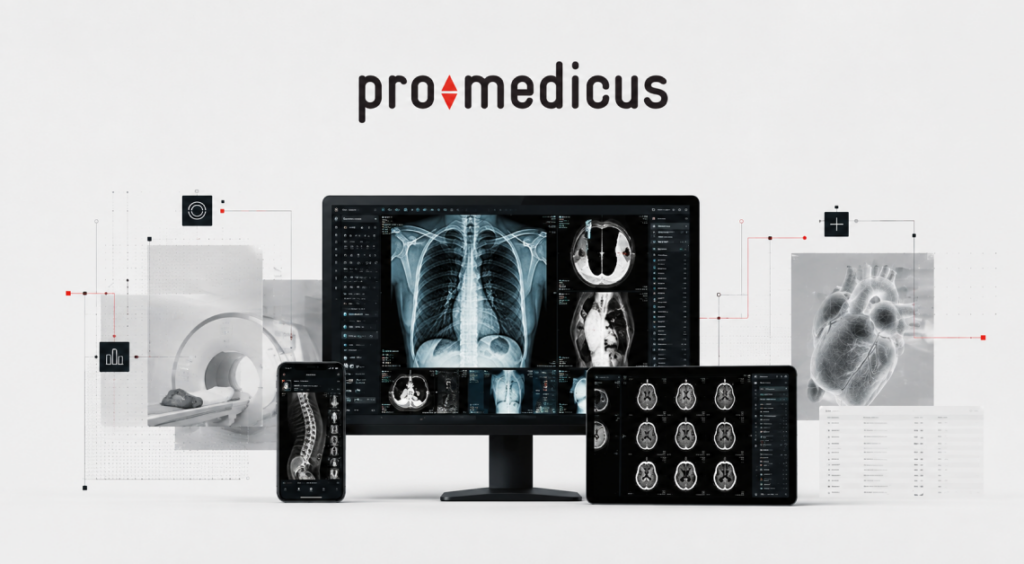
Pro Medicus says Visage 7 can consolidate capabilities that historically required multiple viewers into a single customisable platform. It supports diagnostic interpretation, clinical viewing, advanced visualisation, EHR and portal integration, as well as mobile access. This solves several problems simultaneously.
Radiologists can access images faster. Technologists can spend less time dealing with technology and more time with patients. Referring physicians can access imaging results more easily. For IT departments, consolidating multiple systems can simplify infrastructure and reduce complexity.
Here, the important business lesson is that Pro Medicus was not merely selling another piece of healthcare software. It was attempting to remove friction from an increasingly important clinical workflow.
North America Became the Growth Story
North America has become the company's dominant market, contributing to more than 90% of Pro Medicus' revenue in FY2026. The company landed nine of its 10 new FY2026 contracts in the US, with the remaining one in Europe. Pro Medicus now operates from Melbourne, Berlin and San Diego, while its technology serves hospitals, imaging centres and healthcare groups worldwide. The scale of recent contracts demonstrates the size of the opportunity.
During FY2026, Pro Medicus secured 10 new contracts worth at least A$407 million. Nine of these were in North America. The company also renewed six contracts worth A$141 million. Among the major wins was a 10-year, A$170 million agreement with UCHealth Colorado and a seven-year, A$90 million contract with Beth Israel Lahey Health.
Pro Medicus FY2026: The Numbers Behind the Business
| Business Metric | FY2026 |
| Revenue | A$261.7 million |
| Revenue growth | 22.9% |
| Underlying EBIT | A$196.1 million |
| Underlying NPAT | A$144.7 million |
| Reported NPAT | A$265.3 million |
| New contracts | A$407 million+ |
| Contract renewals | A$141 million |
| Underlying EBIT margin | 74.9% |
These numbers illustrate something unusual about Pro Medicus. The company operates in a highly specialised market, yet it has built a business with substantial profitability while continuing to expand internationally.
An Industry Preparing for Its Next Transformation
Medical imaging is now entering another phase. Cloud computing, artificial intelligence, remote access and interoperability are changing expectations around medical imaging platforms. Modern PACS environments are increasingly expected to work across departments and locations while integrating with broader healthcare IT systems. Research published in 2026 describes PACS as evolving from basic image access towards broader workflow intelligence.
The market opportunity is expanding alongside these changes. A 2026 industry estimate puts the global medical imaging management market at approximately US$5.6 billion, with the market projected to reach US$9.2 billion by 2034.
For Pro Medicus, this creates opportunities beyond conventional radiology. The company has been expanding its technology into areas including artificial intelligence, digital pathology and other imaging applications. Its FY2026 results highlighted new product development and continued investment in expanding the Visage platform.
The Entrepreneurial Lesson Behind Pro Medicus
The Pro Medicus journey offers a valuable lesson for today's founders. The company did not begin with the ambition of becoming a global healthcare technology powerhouse. It began by applying computing to practical problems in healthcare. Then the founders followed where the problems were becoming more difficult. From medical administration, Pro Medicus moved towards digital radiology. From radiology software, it moved towards enterprise imaging. Through the acquisition of Visage Imaging, it gained technology that could address the growing complexity of medical imaging at a much larger scale.
That evolution is arguably the most important part of the company's story.
Pro Medicus built its competitive advantage by understanding a specialised industry deeply, rather than trying to serve everyone.
More than 40 years after its founding, the strategy is reflected in its financial performance. FY2026 revenue reached A$261.7 million, while major new contracts demonstrated the willingness of large healthcare organisations to commit to its technology for many years.
For Australian entrepreneurs, there is perhaps an even bigger takeaway. A global technology company does not necessarily have to begin in Silicon Valley. Pro Medicus began in Melbourne in 1983 with a doctor, a technology specialist and an idea about how computers could improve healthcare.
Four decades later, that idea sits inside a global medical imaging industry that is becoming more digital, more data-intensive and increasingly powered by AI.
The opportunity Pro Medicus identified was not obvious to everyone at the time. That is often where the biggest entrepreneurial opportunities begin.
Sources:

Vishal is an experienced Editor at Inspirepreneur Magazine with key interests in artificial intelligence, eCommerce, entrepreneurship, lifestyle and startup sector. Prior to joining Inspirepreneur, he was a Content Writer cum Correspondent at Siliconindia Magazine, where he worked on Company Profiles, Cover Stories, Executive Profiles, Feature Articles and Thought Leadership content.
You Might Also Like

‘Big Tax Changes’: Chalmers Says Australia Budget 2026 Will Help Address One Nation Surge

Eli Lilly to Build $3.5B Obesity Drug Plant in U.S.
