


Jaimie Fuller’s SKINS Failure: How a Bad Deal and Debt Led to Bankruptcy
Synopsis
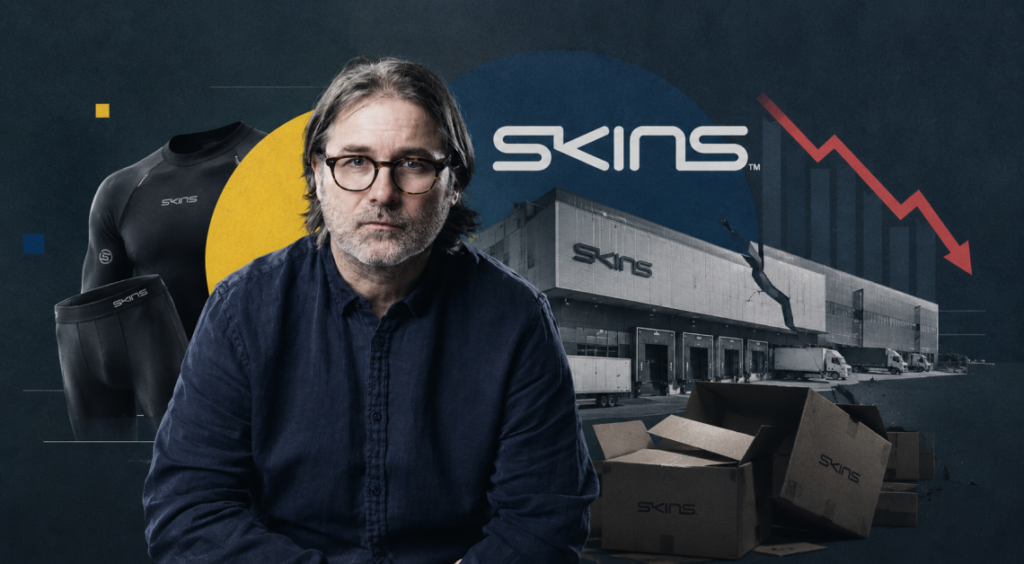
Jaimie Fuller rebuilt SKINS into a global sportswear brand over 17 years, only to watch one private equity deal and its debt bury the company by 2019.
SKINS was one of the most recognised brands in compression sportswear, a global company with elite-level athletes representing them on sport’s biggest stages. Jaimie Fuller was the man behind that company, he had already saved it once and spent 17 years building an international presence. The company he was rebuilding went bankrupt in Switzerland in January 2019. Even by the end, it was a well-rated brand. Here is the story and the scenes you don't know about.
About the Founder
Jaimie Fuller is an Australian businessman, who has achieved fame as a sports executive. Words like ‘international clout’ are never found to be used sheepishly in his case as he earned his position by acquiring SKINS in 2002 and transforming it from just a company into a boardroom name for compression sportswear used by elite athletes and sporting teams globally. While running SKINS, Fuller was a vocal critic of global sport and used his profile to speak out against governance issues at bodies like FIFA.
Fuller had already proved himself adept at turning around a failing business before SKINS collapsed. In 2002 he bought the company when it, as is usually the case with synergy projects, was in crippling debt, poured in his money and managed it for all of its 17 years bringing it from near failure to global brand recognition. This initial bailout is actually part of what makes the subsequent bankruptcy such an archetypal tale of a colossal business failure.
A Business on Its Knees
Jaimie Fuller did not launch SKINS. Brad Duffy originally launched the brand in Australia back in 1996. But by the time Fuller purchased the business in 2002, it was already near the end of its rope and nearly out of cash.
At the time of purchase, Fuller invested personally in the business, meaning that the turnaround was financed through personal funds rather than third-party investors. This gave him complete control with no terms from anyone else regarding the rebuilding of the business.
All about Elite Sport
Fuller did not find a place for SKINS as another generic activewear brand competing on price or convenience; he made it an elite sport. The idea was to sell the product to professional athletes and sporting teams, on the strength of their endorsement and sell that brand to everyone else.
This was more targeted than just going after the mass market from day one, but it gave SKINS something that a normal activewear brand did not, evidence from elite competitors that the product worked.
This is also what has historically differentiated SKINS from almost every other compression wear on the market at that time. The category itself was new in the eyes of most consumers, and a brand needed some help justifying the premium price attached to its product. That role was served by elite endorsement without SKINS needing to put money into educating the market from scratch.
Scaling into global business
The strategy paid off. SKINS expanded well beyond Australia throughout the 2000s, running operations in eight countries with customers in approximately 31 countries globally. Boasting sales of around 100k units a month, enough to lift the company from a fledgling sportswear nameplate to an established international brand.
Sponsorships reinforced that position. SKINS sponsored the USA Cycling team at the London Olympics: exactly the sort of sponsorship that kept the headline-grabbing brand loitering around in elite sport, while behind the scenes its business has been growing.
That scale-up was paid for, financially or reputationally. The line that SKINS didn’t pay sports stars to wear its products created a marketing campaign, which resulted in a legal battle. Fuller later estimated that his decision to fight the ACCC over the campaign ultimately cost about $2.5 million, including the costs associated with his private-equity partner.
The Worst Deal Fuller Ever Called
With the business booming and in need of cash, Fuller turned to institutional capital via a private equity deal in 2007. The typical deal works in a way that investors will receive an ownership stake in the round for cash, in which it is agreed how and when that ownership gets purchased back or exited. Fuller himself has since called this arrangement his “worst-case private equity scenario”.
The timing was harsh. In 2008, less than a year after the deal was signed, the global financial crisis struck, putting pressure on the business just as it was adjusting to its new financial framework.
Buying Back Control at a Price
After 2012, Fuller wanted out of the private equity deal completely. Getting there wasn’t free. He funded this by taking out a huge loan and swapping an equity stake for a debt obligation to buy the investors out.
This one transaction changed the shape of the company’s balance sheet. Fuller said the debt changed the company’s priorities: it went from being a dynamic, entrepreneurial organisation focused on building the brand to ‘cash, cash, cash’. The pressure pushed the business toward short-term decisions that, he says, ultimately damaged it.
That’s a trade-off many founders make without openly feeling the costs until two years down the line. If an equity investor takes a 70% loss in his investment if anything goes wrong. A lender doesn’t. But after SKINS swapped one for the other, every further decision wasn’t just made with an eye on what was good for brand health, but rather what a loan repayment plan would allow.
When the Lender Took the Distribution
The debt had not sat quietly on the books. In his new book, Fuller explains that once financing was secured, the firm ran SKINS from the back end by obtaining distribution rights.
The impact showed up fast. But what it showed was that distribution income (which had been running at about $8 million) plummeted below $2 million in the 12 months after that change, and continued to halve from there. That was a direct strike to the cash the business needed to survive for a company that used distribution revenue to both service its debt and fund day-to-day operations.
Distribution rights are important because they determine how a product gets into the hands of the company and onto shelves or athletes. So if that channel resides with a lender and not the brand itself, the people running the business lose an important lever they would typically pull to right themselves in a sales slump. SKINS was not solely having to contend with lower sales. I also learned that it had lost part of its own ability to respond to them.
The Cycle Fuller Labelled as Three Years of Hell
Fuller has explicitly characterised the last three years of SKINS being an independent entity as hell, and the reasons behind that descriptor are simple enough. Debt repayments needed cash. The requirement for cash forced the firm to make short-term decisions instead of investing in the brand long-term. These short-term decisions pulled the underlying business down. The business was weaker, which made the debt more difficult to service. Each stage fed the next one.
What did not fail here is also worth mentioning. SKINS retained an established global brand, genuine customers, and high-level sports partnerships developed over almost 15 years. The product and the market position were still there. The financial structure underlying them had broken, and brand strength alone couldn’t repair a balance sheet.
The Financials Behind the Collapse
The narrative is evident on its own when you line the numbers up together. In 2002 Fuller bought SKINS, a brand that was already nearly out of money since being launched in Australia back in 1996. Over the next 17 years, he ran it from that low to a business operating in eight countries, with clientele-wise buyers in some 31 nations worldwide and sales of approximately 100,000 units a month.
Financial problems began with the 2007 private equity deal which also brought outside capital in exchange for what Fuller has described as his worst deal. In 2008 came the global financial crisis, during which Fuller had borrowed heavily to pay off and regain complete control from private equity investors in full.
It is the borrowing that leads to the real damage. After the buyout lender assumed distribution rights for SKINS, annual distribution income fell from $8 million to just under $2 million within a year, and kept falling even after that. Separately, a legal case related to one of the brand’s marketing campaigns has already set the company back about $2.5 million. That combination of numbers helps to explain how a business with real global scale and true sales volume managed in less than ten years to take on debt, to the point of running out of financial headroom culminating in its January 2019 bankruptcy filing.
A 17-year Standoff Concludes in Switzerland
In January 2019, SKINS’ parent company filed for bankruptcy in Switzerland. Fuller said his management team had exhausted every option to avoid the filing, but the company’s debt had become unsustainable
He was blunt about the cause. Fuller said it was the 2007 private equity deal and more borrowing that followed in 2012 that were key reasons why the business ultimately failed rather than any single external shock.
The bankruptcy marked the end of Fuller’s 17-year run leading a company that he built back from the brink of collapse into a global sportswear powerhouse. As a brand, SKINS survived the company’s collapse - by then owned by Symphony Holdings which acquired it out of administration along with its intellectual property from Fuller.
That’s a distinction worth meditating on. The remainder of the product SKINS made; the athletes it clothed; the market it had built over 17 years outlived the company structure Fuller had established to run the business. The brand didn’t fail. Below that, the financial setup did.
Fuller arrived at eo after this failed endeavour. [Read the success story here.]

At Inspirepreneurs Magazine, covering entrepreneurship, business failures, and the human stories behind the world's most ambitious founders. She writes at the intersection of strategy and storytelling.
You Might Also Like

France to Recognise Palestine State in September, Macron Confirms

Nearmap Case Study: From Aerial Imagery to a Full-Stack Property Intelligence Platform
