The Revival of Colette: How a Failed Retailer Found a Second Chance
Synopsis
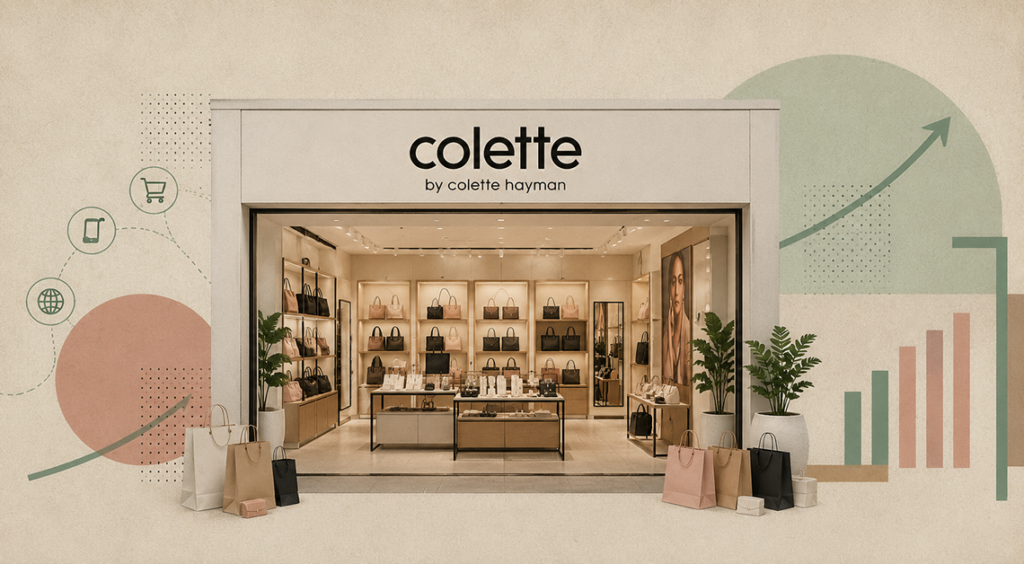
Colette by Colette Hayman’s journey from retail collapse to digital revival highlights how strong branding, disciplined cost management, and a digital-first strategy helped give the iconic Australian accessories brand a second chance.
When Australian accessories label Colette by Colette Hayman went into voluntary administration for the second time in less than five years, many believed it was a sign that was the end for the locally loved fashion sensation. The store, which was going to be making more than A$140 million+per annum in revenue by this point in time, has closed dozens of outlets, lost thousands of people, and been forced deeper into the mire by constant high overheads and up-and-down consumer demand. To many retail watchers, it seemed like another victim of the ever-changing face of Australian retailing.
Yet Colette was not through with their story. The new owners, instead of attempting to salvage the business with the same strategy that led it to collapse in the first place, decided to go in a completely different direction. The company was retraining to be smaller, stronger and more online and less reliant on inventory. The rejuvenation of the company is a reminder that success after failure often comes not from doubling down but from changing course.
Turning the Page with A New Owner
Marquee Retail Group bought the remaining business after Colette went into administration in 2024. Instead of jumping stateside to grow as fast as possible again, the new owners started by figuring out what pieces of it they should hold on to. Although its store network was smaller than ever, Colette still had high-profile status with Australian shoppers who recognised the brand as affordable handbags, travel accessories, jewellery and fashion basics.
The new management recognised that the key asset of the company was not its store count, but rather it was the amount of trust accumulated over many years with their customers. It became protecting that brand value and building a retail business that could simply make cash consistently rather than chasing aggressive growth.
That was a radical shift in strategy. Opening up an additional location was no longer used as a metric for growth. Rather, success would be based on increasing efficiency, improving relationships with customers and making certain that any business decision was long-term sustainable.
Making the Business Smaller to Make It Stronger
Reducing the physical footprint of the company was referred to as one of their priorities. At its zenith, Colette even had a presence in nearly every major retail centre across Australia and New Zealand. The strategy gave the company more exposure, but it also tied the company into expensive leases that became hard to support when customer traffic slowed.
The new business plan, which focused solely on stores that remained successful. We were able to cut rent expenses by closing some underperforming locations and reducing staffing costs and operational complexity. It also let management focus its resources on stores that performed the best in terms of sales and customer engagement.
This “shrink to grow” strategy has been more prevalent in global retail. Today, many of the best-performing retailers see that running a smaller number of profitable stores is far healthier than propping up an extensive network of stores that are continually losing money. To Colette, becoming small was her first step to becoming more powerful.
Building a Stronger Digital Business
Bolstering its online business has been a key element of Colette’s rehabilitation. Over the years, consumer shopping habits dramatically evolved with more customers browsing, comparing and buying products online. This transition has been hastened by the pandemic, ensuring that e-commerce is a vital element of any successful retail operation.
Instead of being dependent on online shopping foot traffic, Colette spent the past few years developing its digital space. And customers were able to more easily find new collections, order goods online and receive them anywhere in Australia. This enabled the company to serve customers without carrying all the overhead of stores in hundreds of locations.
Likewise, online retail presents information about customer behaviour. With this in mind, Colette could adapt quickly to changing consumer preferences, make better business decisions and understand purchasing trends, the most popular products and seasonal demand. After the restructuring, digital sales became one of the company’s biggest growth opportunities.
Efficient Inventory and Intelligent Cost Management
Before its demise, one of Colette’s biggest flaws had been how it managed inventory. With hundreds of stores to man, inventory soon became an issue and failure to drive a sale from products often resulted in heavy discounting across the brand. It shrank profits while starving cash and locking in resources on the shelf.
Management now behaved in a far more disciplined manner, following the restructuring. Stock levels were much better planned, product orders were more strategic and inventory was adjusted with increasing speed to meet customer demand. Storing less excess stock led to lower storage costs, in addition to better cash flow around the business.
The company also focused more on controlling costs at that point as well. Every marketing, operating and investment decision was made with an eye towards its profit improvement capability as opposed to just revenue growth. Financial discipline of this nature provided a much sturdier base than the previous path of rapid growth which had propelled the company forward for years.
Growth Can Just Be As Simple Focus On Profit
The insight from Colette’s failed earlier turnaround was that eye-watering sales alone don’t make a sustainable business. The retailer enjoyed annual sales of more than A$140m at its height, but the company began to feel the strain as rents increased, operating costs surged and financial obligations mounted.
The new management adopted a different strategy instead and made profitability the main success metric. The company decided to protect margins, conserve cash and make sure each business unit generated positive value, rather than just trying to take up space on the map by opening more locations.
These disciplined techniques helped reduce capital threat and gave greater flexibility to adjust content quickly or, whenever necessary, begin in a brand new conversation. The long-term vision was changed from fast expansion to sustainable growth for the company.
The Operating Model in the Age of Modern Retail
With all shopper behaviour, from looking for products to translating them into purchases having moved online, Australia’s retail scene is evolving. Along with traditional in-store experiences, customers now expect competitive pricing and flexible delivery options when they shop online. Retailers that are slow to adapt often find themselves fighting the battle to stay relevant.
In answer, Colette has reacted with a spirit of communion between its bricks-and-mortar business and the major online presence it recently established. From its strategy standpoint, the company did not treat stores and e-commerce as two separate businesses but rather viewed them as complementary halves of an integrated customer experience.
This flexible model enables the business to follow the customer and wherever they want to shop, without many of the fixed costs that come from a huge physical retail format. It also ensures a new steady, enduring lower as consumer tastes change.
Conclusion
The return of Colette by Colette Hayman shows us that business failure doesn’t have to be the end. At times it creates a chance to rebuild stronger with more solid foundations, improved financial prudence and more clarity about what customers actually want. The company took a more prudent approach centred on profitability, efficiency and digital growth instead of revisiting the previous strategy that had driven runaway growth.
While there are remaining challenges, the turnaround success at Colette can provide essential takeaways for companies in any industry. But scaling quickly is not always the way to long-term success. Careful cost control, adaptation to market changes and emphasis on sustainable growth make a business far sturdier than those based on rapid expansion. Colette proves that endurance not bigness is the key to a company thriving beyond survival in its second chapter.
Follow Inspirepreneur Magazine for daily global business news

At Inspirepreneurs Magazine, covering entrepreneurship, business failures, and the human stories behind the world's most ambitious founders. She writes at the intersection of strategy and storytelling.