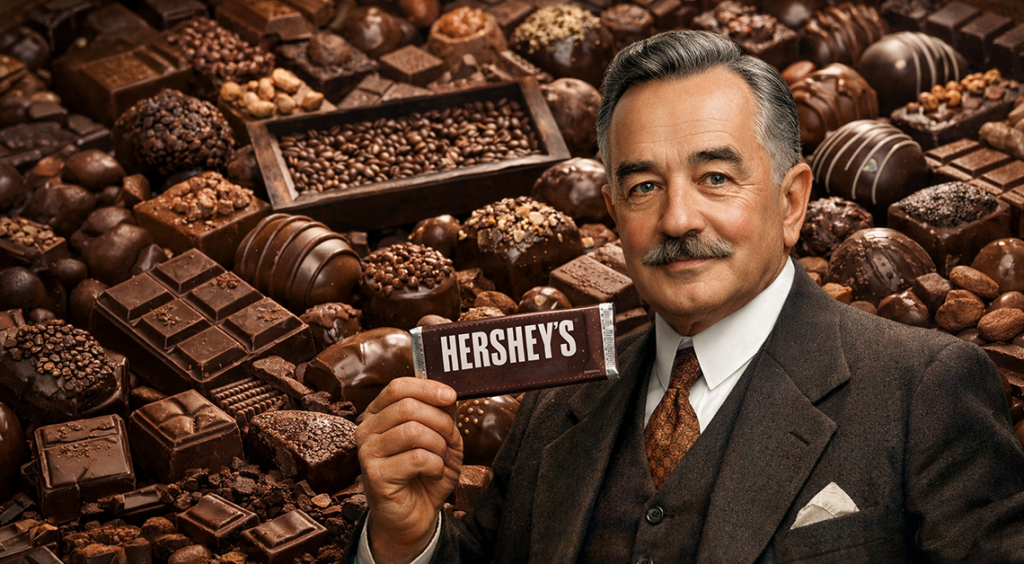
The Man Who Made Chocolate for Everyone: The Success Story of Milton Hershey
Synopsis
Milton Hershey transformed chocolate from a luxury good into an affordable treat for millions. Through grit, good business sense and insistence on quality, he built one of the world’s best-known chocolate brands. It wasn’t always easy, but he had a different vision where everyone could enjoy chocolate. Hershey also built one of the best work environments, giving his labor force a Colleges and parks for Families, creating a work environment beyond business-solidarity. His story exemplifies the ways his ingenuity, graft and big-heartedness turned a simple ambition into an enduring legacy that continues putting smiles on the faces of countless millions around the globe.
The Hershey’s stores you walk into today have Kisses wrapped in silver foil or the simple brown chocolate bars. It’s difficult to picture a world without them. But before Milton Hershey changed the game, chocolate was a luxury few people outside of fancy cities could enjoy. Milton changed all of that. He built not just a factory: he built a town, a school and a legacy that helps kids still to this day.
A Huge Gamble on a New Idea
By 1900, Milton Hershey was a very rich man. He owned a huge business manufacturing caramels in Lancaster, Pa. Most people by now would have just retired and spent the money. But Milton had never forgotten something he’d seen at a big fair in Chicago: German chocolate-making machines.
At the time, chocolate was difficult to produce and extremely pricey. Milton had a gut feeling that chocolate was it. He did something his buddies thought he was nuts about, he sold his whole caramel company for $1 million. He pulled all of that money, every single cent, and was going to bet it on milk chocolate. Caramel, he famously declared, was merely a passing fancy; chocolate would be what people craved for all time.
The Secret in the Milk
The biggest issue back then was that no one knew how to make good milk chocolate in America. The Swiss had the secret, and they weren’t telling. That is why milk chocolate is slightly difficult to produce, as milk goes off much faster than solids. If you go wrong in the formula, the chocolate will taste bad or get lumpy.
Milton went back to the countryside where he grew up. It wasn't only because he longed for his home that he did this; it was for the cows. To make the best chocolate, Milton needed a constant supply of fresh milk, and he knew that only local milk could provide this.
For three years he converted part of his farm into a laboratory. He failed hundreds of times. Sometimes the milk would burn; sometimes the chocolate wouldn’t stay smooth. But he kept at it. Eventually, he devised a unique process to condense the milk so it remained fresh and imparted a tangy flavour on chocolate that came to be known as the signature Hershey taste.
A Factory in the Middle of Nowhere
In 1903, Milton began constructing what would grow to be the world’s largest chocolate factory. He didn’t build it in a major city like New York or Philadelphia. He made it smack in the middle of a Pennsylvania cornfield.
He could also spray the beans through giant machines and then buy milk from all of the local farmers, enabling him to create chocolate bars far faster and cheaper than anyone else. He slashed the price of a bar to only five cents. All of a sudden, an honest farmer or factory worker could afford to offer their child a piece of chocolate. It was no longer a rich person’s treat. It belonged to everyone.
Building a Town with a Heart
Milton knew that treating workers like family makes them work harder for you. Where other business owners had a reputation for being mean or miserly, Milton was not. He wanted his workers not live in crowded dirty apartments.
He constructed an entire town around his factory. He ensured that the houses included nice yards and modern plumbing. He constructed a field for the families to play on, a zoo, and even erected a beautiful theatre. He wanted his workers to be happy and proud of where they lived.
When the Great Depression came and much of the country was out of work, Milton would not fire his people. He instead hired them to construct an extravagant hotel and a large community building just so that he could guarantee everyone would still collect their paychecks.
The Famous “Kisses” and the Small Paper Tag
In 1907, the company began producing Kisses. Originally, all of them were wrapped by hand. Eventually, they had a machine that did it. Ever wondered about that little paper strip sticking out of the top? Milton added it so that people would know it was a real Hershey’s Kiss. He said, ‘This is the real thing;’ there were so many people trying to copy his success and that little flag was it.
Surviving the Hardest Times
Success isn’t always a linear path toward the top. Things got very hard during World War II. Sugar and cocoa were in short supply due to the war. Instead of accepting defeat or compromising on quality, Milton partnered with the government to produce the best possible “Field Ration D” bar.
That was a special chocolate bar that didn’t melt in the heat, giving soldiers energy. It tasted more like an oat cracker than a confection, but it was saving lives and keeping the factory alive when other candy manufacturers were going bust. It displayed how Milton cared more about helping the country than simply profiting.
The Power of Being Kind
What actually made Hershey’s business successful was not just the chocolate; it was the trust that people had in him. Milton never invested heavily in extravagant ads. Rather than taking such a step, he gave the product and his deeds the chance to express their merit and value.
His usual pastime was to stroll through the factory and chat with the employees, asking about their families. Recognising them by names he had established a team loyal enough to never leave him. Yet at heart, if you are kind to people, they will help you make something that will last for eternity and that no machine can ever match.
His Greatest Gift: The School
Milton and his wife, Catherine, were very sad that they could not have children of their own. They had so much money, and no heirs; they would be parents to children with nobody else. In 1909, they opened a school for orphaned boys.
But here is the most incredible part of this story: In 1918, when his wife died, Milton secretly transferred everything he owned, his houses, his land and a controlling interest in the chocolate company, to the school’s trust. He did not tell anyone for five years. He basically sold his own labour to the school and all the profits belonged to the school. Today that school, The Milton Hershey School, is one of the richest schools in the world, and it continues to provide a home and education free of charge to thousands of kids in need.
Carrying the Dream Forward Today
Milton Hershey died in 1945, but his chocolate dream is still alive. Today, the people leading the company have a huge task: to ensure that the business remains successful so that the school can receive funding.
- Kirk Tanner (CEO)– Is the Man running the company as of early 2025. He replaced Michele Buck, who did an admirable job expanding the company beyond just chocolate (he now owns brands such as SkinnyPop and Dot’s Pretzels). The job of Kirk is to help keep the factory running smoothly and keep the brand up to date.
Milton Hershey showed that you need not be a shark to win in business. He created an empire by being nice, sticking to his thinking when things got tough, and ensuring that at the end of the day, someone else benefited from his success.
To know more about Hershey's and their business visit their website, X, Facebook, Instagram, LinkedIn, and YouTube.
Follow Inspirepreneur Magazine for more business failure stories of founders and entrepreneurs from around the world.

At Inspirepreneurs Magazine, covering entrepreneurship, business failures, and the human stories behind the world's most ambitious founders. She writes at the intersection of strategy and storytelling.