


From Loss to Billions: The Rise of Laurence Escalante’s VGW
Synopsis
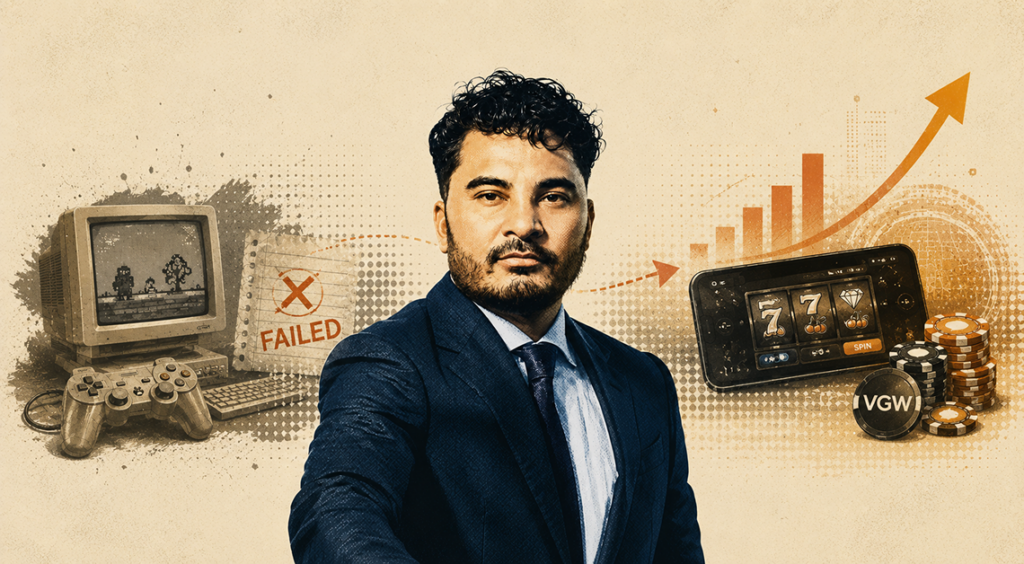
After White Knight Games failed, Laurence Escalante started again with VGW in 2010. Here’s how a different business model, digital distribution and social gaming helped turn his second venture into a multibillion-dollar success.
Laurence Escalante went broke on his first business. His second quickly became one of Australia’s largest private tech companies, based around a model that was almost unique in the market back then. So this is the story of how Virtual Gaming Worlds, VGW was built, what kept the model working in reality and some statistics backing it up during its growth.
Reinventing A New Life From The Co-Working Desk
Escalante began working on Virtual Gaming Worlds from a co-working space in Perth in 2010. No big office, no sizable team, and not even any external wealth supporting him. He was still in the red from his time at White Knight Games and this is not a relaunch with new money: this is a rebuild.
It was a relatively simple pitch for the new business. In a too-early pitch, he explained VGW’s concept for fusing social gaming with gambling. That very phrase drove the entire internal logic of our company, and it is worth marinating on because it’s not really a gaming insight; it’s a regulatory insight.
One major insight was this: gambling with real money online was highly regulated and largely against the law in the United States. However, social games which people were already playing for free on Facebook without any real money on the line, were not. Escalante designed VGW specifically to be straddling both of those worlds.
The Strategy: Sweepstakes Gaming
VGW's actual product took a while to form. Also in 2012, the company opened Chumba Casino which was its first real interactive sweepstakes casino that initially only featured slot-style games but eventually added table games like blackjack and roulette. Then it had a payment structure underneath it that made it different from your usual internet casino.
Chumba Casino operates through two currencies. Players can purchase Gold Coins, which are used for social-casino gameplay and cannot be redeemed for cash. Separately, Chumba offers Sweeps Coins as promotional currency that can be used in sweepstakes games for the chance to win cash prizes. Importantly, players do not have to purchase to participate in the sweepstakes; U.S. sweepstakes rules generally require a free method of entry and prohibit making a purchase a condition of winning or increasing the chances of winning.
This is the reason why, up until this date, VGW may operate in dozens of US states with no need for a state gambling license. Instead, it is licensed by the Malta Gaming Authority, a regulator used by many offshore gaming operators. According to recent reporting, VGW’s games are live in 36 states, but six states have banned the sweepstakes model entirely, including New York, New Jersey and Delaware, and a further eight allow free-play only.
Building Out The Product Line
When VGW announced the launch of Global Poker in late 2016, an online poker room based on similar sweepstake technology, the site quickly grew to become one of North America's fastest-growing social poker sites. A second entry, in the form of a casino-style brand named LuckyLand Slots, was introduced two years later ( 2018 ).
VGW also tested products outside its main casino and poker businesses. Scratch Carnival, launched in 2020, brought the sweepstakes model to a scratch-card-style game, while FendOff Sports took the concept into sports predictions. Neither gained enough traction to remain part of the portfolio, and both were eventually discontinued.
When VGW launched LuckyLand Casino in 2025 as an extension of the LuckyLand brand, its core business was already centred on three major products: Chumba Casino, Global Poker and LuckyLand Slots. Chumba continued to be the company’s dominant revenue source, accounting for 67% of VGW’s total revenue in 2024, according to Forbes.
The Numbers Behind The Growth
VGW’s early funding was small potatoes for the tech industry. According to filings, it raised a total of approximately $2.5 million-$2.61 million in its early rounds, starting with an initial Series A round during March 2013. At the time, VGW had more than 40,000 users, with the funding allocated to developing and marketing Chumba, expanding the platform across Facebook and mobile, and meeting gaming-licence requirements.
However, it was through the Covid-19 pandemic that a real turning point for you was instigated. Lockdowns forced tens of millions of people onto social media, and VGW has leaned heavily on paid social media to meet that demand. Having previously described boosting the firm’s social media presence as a major inflection point, Escalante explained to The Australian that during this time, the company went from 10,000 monthly users to over one million.
The revenue growth that followed was remarkable. By early 2024, VGW had already become Australia’s sixth-largest private company by revenue, reporting A$2.8 billion in revenue and A$207 million in net profit for the six months to December 2023. For the full financial year ended June 2023, revenue had reached a record A$4.84 billion, while net profit came in at A$377.6 million. By 2024, VGW’s turnover had risen above A$6 billion, according to The Australian.
What Actually Underpinned The Growth
Here are two reasons why VGW scaled as quickly as it has, and both of them hark back to lessons that were learnt at White Knight Games, almost painfully perhaps. The first is distribution control. VGW was also different from his first company, which relied entirely on an external publisher to get in touch with customers; instead, VGW ran its own acquisition arm right through its own marketing spend and with no intermediaries controlling the relationship with players.
The second is regulatory structure. Instead of competing in an extensive, regulated and high-licensing gambling market like most major gambling companies, VGW has wholly hedged their business on a legal form of the game called sweepstakes law that allows it to operate at scale by dodging costly licensing requirements and state-by-state approvals required for most traditional casino operators. The biggest source of risk related to that structural choice is ongoing for the company, too, now it is subject to legitimate legal challenges. State-level enforcement actions have also been taken: Louisiana has sued VGW and a company that provides associated services for failing to pay taxes related to the company’s sweepstake model.
Escalante’s position in the company had also evolved by 2025. His purchase of the minority shares in VGW, which at the time had not long been valued at a greater than $2b price tag made perfect sense against a business at that stage worth multiple times over on an annual revenues front.
Where The Business Stands Today
Escalante became a self-made billionaire as VGW soared. He was ranked 32nd in Australia on the Australian Financial Review’s 2025 Rich List with an estimated personal fortune of A$4.37 billion. He also made the global billionaires list from Forbes this year, which has now adjusted its estimate of Blume’s wealth due to changes in VGW’s valuation and ownership position.
The company has not been without its share of bumps in the road. Even the founder has legal troubles of a serious nature in 2026 as several US states have been continuing to attempt legislation targeting the gaming sweepstakes model altogether, posing actual regulatory uncertainty into the future. None of that takes away from what the business itself pulled off: A couple billion-dollar empire built in fifteen years from a co-working desk by a founder coming out of debt, with a legal structure literally no one had scaled that before.
That is the fundamental business lesson underpinning the VGW story. Escalante started his first company, only for it to flounder, because he was completely reliant on someone else’s balance sheet and someone else’s channel to deliver customers; His second company worked by owning those two things outright, and by stumbling upon a legal structure that gave it space to expand before the remainder of the industry, or its regulators, could catch up.

At Inspirepreneurs Magazine, covering entrepreneurship, business failures, and the human stories behind the world's most ambitious founders. She writes at the intersection of strategy and storytelling.
You Might Also Like

Australia’s Stock Secrets: Uncovering Growthpoint’s Power Players

Quad Ministers Meet In India As Indo-Pacific Tensions Push Bloc Back Into Focus
