


What Is OpenAI Worth and How Can Australian Investors Access the ChatGPT IPO Before It Lists?
Synopsis
Discover OpenAI’s latest valuation, IPO timeline, ownership structure, and the different ways Australian investors can access ChatGPT’s parent company before and after its expected US stock market listing.
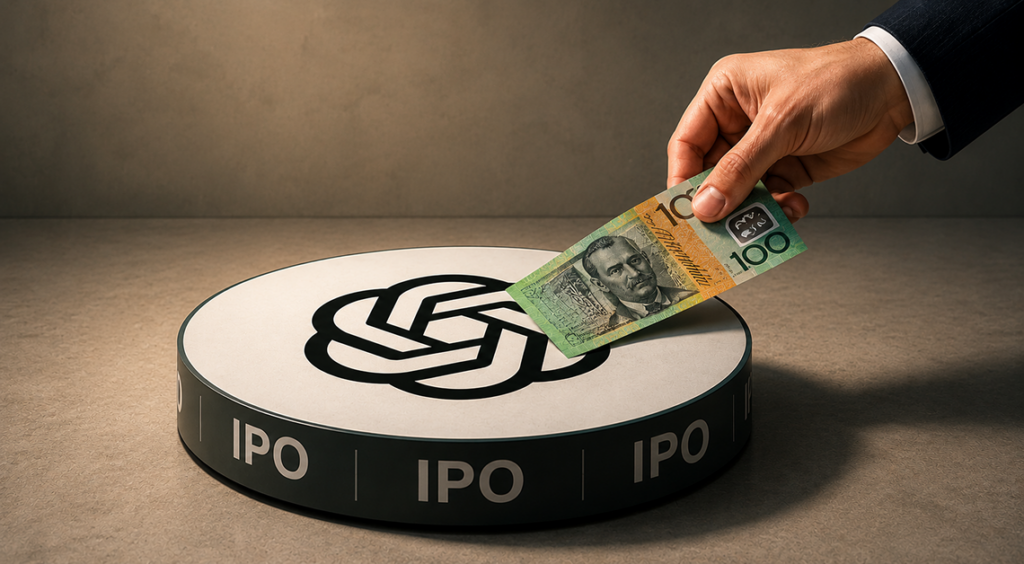
It is now commonly known by every household that ChatGPT is made by OpenAI. What may be more interesting is that OpenAI has confidentially filed paperwork to go public with the US Securities and Exchange Commission on 9 June 2026.
They want to be a public company and this could make OpenAI worth up to US$1 trillion. For context, Meta debuted at US$104 billion in 2012 and Uber at US$82 billion in 2019. This would be way bigger, than both Meta and Uber if this happens.
For investors who've been watching the AI boom from the sidelines, this feels like the moment for which investors have been waiting. But before you start picturing what your portfolio looks like with OpenAI there are a few things worth understanding first.
What OpenAI Actually Is (And How It Makes Money)
OpenAI is best known for ChatGPT, but it is used for much more than chat. Its AI models help people write, code, create images and build tools for businesses.
They usually earn money through paid ChatGPT plans and by allowing businesses to use its models through APIs. Microsoft is OpenAI’s biggest strategic partner and uses its technology across products such as Azure and Copilot.
The growth has been remarkable. OpenAI’s annualized revenue grew from $2 billion at the end of 2023 to more than $20 billion by the end of 2025, while internal projections reported by Reuters and The Information pointed to roughly $14 billion in losses in 2026 and profitability only around 2029.
What Is OpenAI Actually Worth Right Now?
OpenAI is currently valued at around US$852 billion, following a US$122 billion capital raise disclosed in March 2026.
That valuation hasn't always been this high. Here's how quickly it's moved:
| Year | Valuation |
| 2021 | ~US$14 billion |
| April 2023 | ~US$27–29 billion |
| April 2024 | US$300 billion |
| October 2024 | US$157 billion |
| October 2025 | US$500 billion |
| March 2026 | US$852 billion |
The speed of that climb tells you something about how much the market believes in where AI is heading. It also tells you something about how much expectation is already baked in.
The Part Most Headlines Are Glossing Over
Both OpenAI and rival Anthropic filed confidentially, which means they've started the process with the US regulator, but the detailed financials actual revenue, profit and costs stay private until a public prospectus is released closer to listing.
So while you're seeing a US$1 trillion valuation floated everywhere, nobody outside these companies has seen the audited numbers behind them yet. Those only become public shortly before any listing, and until the full books are open, the trillion-dollar label is an ambition, not a proven value.
They have not decided on a size or a date for its listing. The Wall Street Journal says that Goldman Sachs and Morgan Stanley are working on the paperwork. They think OpenAI might list as early as September 2026.
Who Actually Owns OpenAI?
OpenAI has an unusual setup. It is made up of a company called OpenAI Foundation and a for-profit company called OpenAI Group PBC. This is how it has been since OpenAI changed its structure in 2025. The OpenAI Foundation owns 26 percent of the for-profit OpenAI Group PBC. Microsoft owns around 27 percent of OpenAI Group PBC. The rest of OpenAI Group PBC is owned by the people who work at OpenAI, the leaders of OpenAI and the people who first invested in OpenAI.
It's not a typical corporate setup. OpenAI is a mix of both nonprofit and for-profit models which ideally meant shareholders may have less or no direct control and their return may be not as expected as in a traditional public company. Investors should be mindful before investing if a company gets listed.
How Can Australian Investors Actually Get Involved?
Here's the honest answer: right now, not easily.
OpenAI isn't listed yet, and when it does list, it'll be on either the Nasdaq or NYSE, not the ASX. Australian investors will need a US-market brokerage account, like Stake or similar, to buy shares at the time of listing.
For pre-IPO access, platforms like Forge Global do offer secondary market shares in private companies including OpenAI, but these are typically reserved for sophisticated investors, come at a significant premium, and carry real liquidity risk. This is not the same thing as buying shares on a stock exchange and shouldn't be treated as such.
The more accessible option for most Australians right now is indirect exposure. Microsoft is OpenAI’s largest investor, so buying Microsoft shares gives investors some indirect exposure to OpenAI’s growth. It is not the same as owning OpenAI shares, but Microsoft could benefit if OpenAI continues to expand.
As an investor you can also look at ASX-listed companies such as Weebit Nano, Archer Materials and BrainChip as these are smaller, early-stage AI hardware businesses, so their share prices can be volatile and the risks are higher.
On a larger scale investors can look at the Betashares Global Robotics and Artificial Intelligence ETF for a range of AI and robotics companies, rather than relying on the performance of one stock.
The Risks Are Real
A lot of people will get excited, but history has a way of humbling even the most anticipated tech IPOs. Meta, Snowflake and Arm all had a huge interest before listing, yet they saw significant price swings as valuations adjusted and the market reassessed growth expectations in the months that followed.
An Open AI listing will be the most watched and awaited IPO, so hype on price will be there on day one.
But that doesn’t make it a bad investment. It simply means investors should be careful before investing as Open AI is still investing heavily and yet to reach its profitability as it also operates in a crowded AI market and has a company structure that is different from most listed businesses.
Frequently Asked Question
What is the OpenAI IPO date?
Nothing has been confirmed. OpenAI announced on 9 June that it had confidentially filed with the SEC to pursue an IPO. Reports suggest Goldman Sachs and Morgan Stanley are working on the prospectus, with a listing potentially as early as September 2026, though OpenAI itself has not locked in a date or size.
What is OpenAI's current valuation?
OpenAI is currently valued at around US$852 billion, following a US$122 billion capital raise in March 2026. The IPO could target a valuation of up to US$1 trillion.
Who owns OpenAI?
Can Australian investors buy OpenAI shares before the IPO?
For most retail investors, no. Pre-IPO shares exist on secondary market platforms but are typically limited to sophisticated investors and come with significant risk. The more practical route is indirect exposure via Microsoft shares or ASX-listed AI ETFs while waiting for the public listing.
Is OpenAI profitable?
Not yet. The company is projected to post a US$14 billion loss in 2026 and doesn’t expect to reach profitability until around 2030, despite revenue growing to more than US$20 billion by end of 2025.
Follow Inspirepreneur Magazine for daily global business news.

At Inspirepreneurs Magazine, covering entrepreneurship, business failures, and the human stories behind the world's most ambitious founders. She writes at the intersection of strategy and storytelling.
You Might Also Like
UK Long-Dated Gilts Issuance to Hit 21-Year Low

OwnHome: Making the Aussie Dream of Homeownership a Reality
