


The $12 Million Robot Disaster: How Over-Investment Ruined Australia’s Top Bookstore Booktopia
Synopsis
Booktopia was once Australia’s largest online bookstore and one of the country’s most promising e-commerce businesses. At its peak, the company was valued at $315.8 million and benefited from the online shopping boom during the pandemic. However, an expensive $12 million investment in a robotic warehouse, slowing consumer demand, operational challenges, and mounting debt created severe financial pressure. By July 2024, Booktopia entered voluntary administration owing $60 million to creditors. This case study examines how aggressive expansion and poor timing contributed to one of Australia’s most significant retail collapses.
Booktopia was beloved online retail brand in Australia for nearly 20 years. It started as a humble startup and eventually took the shape of the biggest online bookstore in the country with millions of customers served, building their reputation as an online haven for readers. Starting as a very small business turned into what would be nothing short of one of Australia's greatest e-commerce success stories.
The firm enjoyed a boom alongside the rise of e-commerce across Australia. Booktopia grew, as more consumers embraced purchasing online and built an efficient logistics footprint and favourable partnerships with Publishers. It had indeed grown to become a major player in the Australian book market by the early 2020s.
Nevertheless, more success creates its own risks. Booktopia grew exponentially during the pandemic and expanded heavily, believing demand would go on growing. But those decisions haunted the company when market conditions changed. In July 2024, Booktopia had to go into voluntary administration with around $60 million AUD in debt, bringing one of Australia's most successful retail growth stories into an abrupt halt.
About Booktopia
Online only bookstore Booktopia was launched in 2004, to provide Australian voracious readers with a larger selection of titles than many physical bookstores can accommodate. Back in a time when e-commerce was just emerging the company spotted an opportunity to create a book-centred digital-first business.
The retailer grew beyond its intended scope over the years. With millions more titles spanning fiction, non-fiction, educational resources, children's books and professional titles. Its competitive pricing service, with far-reaching inventory services and delivery was an attraction for customers.
With its continuing growth, Booktopia became a big player in the Australian book business. Publishers depended on the company to ship books across the country; customers increasingly saw it as their go-to source for ordering books online. At its height Booktopia became regarded as the largest online bookseller in Australia.
About the Founders
The business partners were Tony Nash's brothers Simon and business partner Steve Trauer, who founded Booktopia. With a lack of facilities and big dreams, the trio launched from a suburban home in Sydney. They set out to build an online bookstore capable of competing with major retailers while giving customers access to a much broader selection of books at any time of day.
Through consistent growth and carefully planned expansion, they transformed a small startup into a nationally recognised brand. Their journey was widely regarded as an example of how determination, persistence, and innovation could turn a simple idea into a successful Australian business.
The business became more complex as Booktopia grew. Running a large public company is an exercise in making significant decisions around funding, operations & growth. The founders created a market leader, but difficulties in scaling also helped sink the company.
The Pandemic Boom sets very High Expectations
The COVID-19 global pandemic turned out to be one of the biggest growth sprees in Booktopia history. Restrictions throughout Australia sent consumers flocking online, and many turned to books as a source of entertainment and (education) while increasing time spent at home.
Booktopia saw demand for its services skyrocket. Customers ordered quantities of books, which facilitates the company recording sales and attracting considerable investor interest. The retailer seemed exceptionally well placed to make the most of a move towards digital commerce.
The company market value showed this confidence. Booktopia was valued at around $315.8 million AUD in 2021 when its shares were about $3.00 each. The market saw the company as one of the biggest beneficiaries of shifting consumer preferences and management started to prepare for a structurally bigger company going forward.
The Stickup Warehouse that Cost $12 Million
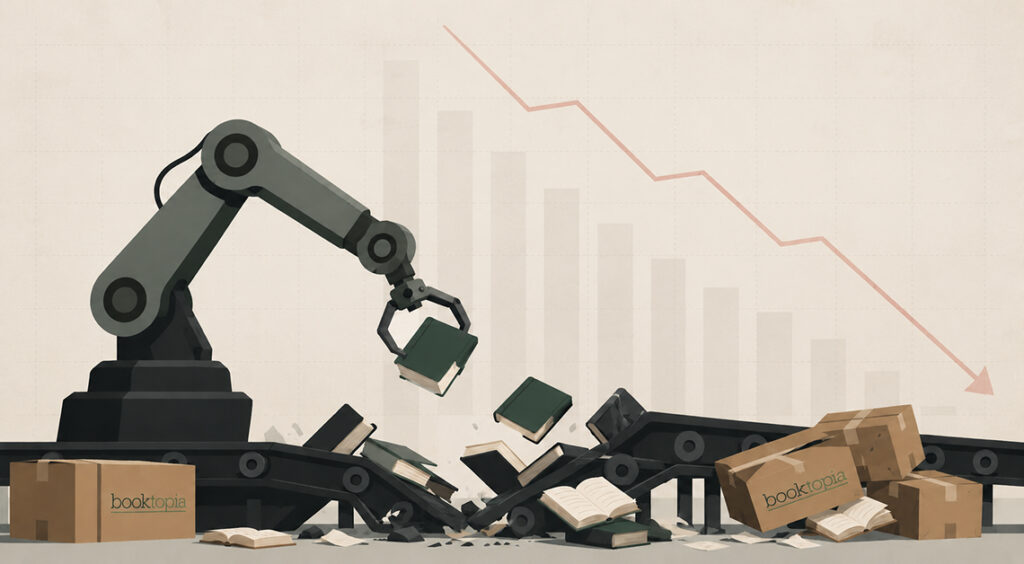
Buoyed by its strong sales growth, Booktopia took the plunge to invest $60 million in a brand robotic centre located in Sydney. The company believed automation would enable it to process orders more quickly, save cost-per-order in the long run and allow for future growth.
The project was one of the largest investments in the company's history. The robotic warehouse system cost about $12 million AUD, with plans for modernizing operations and implementing quicker deliveries in order to serve customers better.
At face value, the investment made sense. They were seeing strong demand, they were growing their sales, and automation felt like the logical next step. The decision, however, took a lot of capital and led to the firm losing much of its financial elasticity. The warehouse went on to be one of the most-discussed factors behind Booktopia's dramatic collapse.
When Consumer Spending started to Drop
By the time Booktopia was investing heavily in automation, outside economic conditions were beginning to change. While the online shopping boom that was fueled by the pandemic eventually ebbed as consumers returned to routine spending patterns.
Meanwhile, inflation surged across the length and breadth of Australia, increasing the cost of living pressure on homes from one end of the nation to the other. The increase in interest rates made budgets more elastic, and so many consumers started cutting back on discretionary purchases.
The firm had invested under the assumption that growth would continue. Rather, it instead found itself in a more challenging consumer environment where demand was beginning to become less stable. Suddenly the warehouse investment timing did not seem nearly so good.
Cash Flow Starts Drying Up
In reality, businesses fail not because they are out of customers, but rather that they run out of cash. With sales growth declining, the strain on Booktopia from the warehouse investment grew heavier.
The company was fairly revenue-generating, but spending towards operations and investment inflows remained a heavy drain on resources. The cash that usually serves as a buffer in tough times had already been used for expansion projects.
As the situation deteriorated, Booktopia ran out of options. The company was faced with cost inflation while hanging on to an expensive capital investment. What should have been aiding in future growth now added to the financial pressure.
The Bonded Debt Regularly Hits $60 Million
Booktopia continued to take on debt as financial pressure mounted. The company had been kept afloat through the goodwill of creditors and suppliers, as well as expensive financial arrangements, while it was trying to ride out slowing growth with an uncertain economy.
The situation had become untenable by July 2024. Booktopia went into voluntary administration with around $60m AUD in debts owed to creditors, publishers, suppliers and other stakeholders. The figure shocked many observers. Just a few years prior, it was one of the most valuable e-commerce companies in Australia. Now, it has risen to the unpayable level of a mammoth debt.
The $315 Million Valuation Wipeout
The most theatrical fact in the failure of Booktopia was the value of money it wiped off for shareholders. The pandemic boom made investors think this company would be a winner and in their generosity handed out a valuation of about $315.8m AUD to reward it for future successes.
With lingering worries around debt, profitability and operational performance taking hold, investor faith evaporated quickly. The market meanwhile started wondering if the company could back up its earlier growth expectations.
Booktopia had declined to around $3.00 per share in June 2024 and downed as low as $0.05 through June 2024. The deterioration erased most of the company's market value and marked one of Australia's deepest retail share price declines. As the crisis deepened, trading was finally suspended.
The 150,000 Customer Orders That Are Now Up In the Air
It involved investors getting decimated in a much broader way than just the collapse. Around 150,000 customer orders were left in limbo when operations were disrupted. Numerous clients had pre-paid for books, their installments were in limbo and they may never get their buys.
The combined worth of these unrealised orders is alleged to be around $12 million AUD. The collapse left confusion, frustration and losses for thousands of customers. The incident eroded trust, revealing the impact of corporate failure on the physical world.
The Problem with a $3 Million Gift Card
Another major problem related to Booktopia's gift cards. When it entered administration, customers still had around $3 million AUD of unused gift cards. A gift card is basically money already paid to a company for future goods or services. Those pledges come hard to honour when a firm goes in administration, and customers wonder whether even their cash can be retrieved.
For many loyal Booktopia shoppers, the gift cards have become yet another emblem of the company's sudden collapse. What was previously a well-worn gift became money invested in a business failure.
Publishers (in particular) and suppliers also paid the price
A devastating blow to Australia's publishing industry. As one of the biggest book retailers in the country, they were a key bridge between books and readers.
Many publishers and suppliers were left waiting for payments when administration first started. Igniting financial uncertainty and pressure on businesses that relied heavily on Booktopia to act as a major sales channel, were unpaid invoices.
Small publishers had it particularly bad as they were less able to swallow a big hit. The bankruptcy showed how the downfall of one big retailer can reverberate through a whole industry.
The Collapse
But the tale of Booktopia took a turn for the serious in July 2024 when it had to call in the voluntary administrators. And what was once Australia's largest online book store had more than $60 million AUD in debt and couldn't handle the financial strain of a tapering off of sales, escalating costs as well as an expensive expansion strategy.
Every big number tied to the business showed evidence of decline for the company. At one point it had a $315.8 million AUD market cap before seeing its share price plummet from $3.00 to just $0.05. This left nearly 150,000 customer orders valued at $12 Million AUD in limbo, and customers sat on around $3 Million AUD of unused gift cards. It invested $12 million AUD into a robotic warehouse to help with future growth, which ultimately became one of the many icons of the collapse.
The fall of Booktopia signaled the end of an era for customers, investors, publishers and suppliers. The company which had spent 20 years establishing its dominance in Australia's online book market had been grounded by a brutal mix of massive expansion, evolving markets and mounting financial stress.
What Happened After the Crash?
Booktopia's story didn't end with the collapse. After administration the company was restructured and trimmed in a bid to preserve the brand under different ownership.
If you want to know about how Booktopia was purchased, what happened after it went into administration and how the business tried to rebuild its operations, read the next installment of events here.
Follow Inspirepreneur Magazine for daily global business news.

At Inspirepreneurs Magazine, covering entrepreneurship, business failures, and the human stories behind the world's most ambitious founders. She writes at the intersection of strategy and storytelling.
You Might Also Like

The Ingredients of a Successful Organization: A Detailed Overview

Virgin Australia’s Return to the Australian Securities Exchange
