


Nvidia Selects China’s Unitree for New Humanoid Robot Platform Ahead of IPO
Synopsis
Nvidia has selected China’s Unitree Robotics for the first humanoid robot platform it is offering to universities and robotics researchers globally. The system combines Unitree’s H2 humanoid robot with Nvidia’s Jetson Thor hardware, Blackwell GPUs and Isaac GR00T AI models for robotics development and simulation. The announcement comes as Unitree seeks to raise 4.2 billion yuan through a planned Shanghai IPO. Nvidia said major research institutions including Stanford, ETH Zurich, Ai2 and UC San Diego plan to use the new platform as the company expands its presence in robotics and physical AI technologies.
Nvidia has decided to partner with a Chinese robotics startup, Unitree Robotics, for the first humanoid robot platform it's offered up.
Key Highlights
- Nvidia chooses Unitree for new humanoid robot platform
- Unitree combines its H2 robot and Nvidia AI hardware to create the system
- Unitree National R&D is Eyeing for 4.2 billion yuan IPO in Shanghai
- Prominent global research institutes are set to utilise a pioneering robot platform
- Nvidia, meanwhile is still on the march with its robotics and physical AI business
Nvidia and Unitree Introduce New Robotics Platform
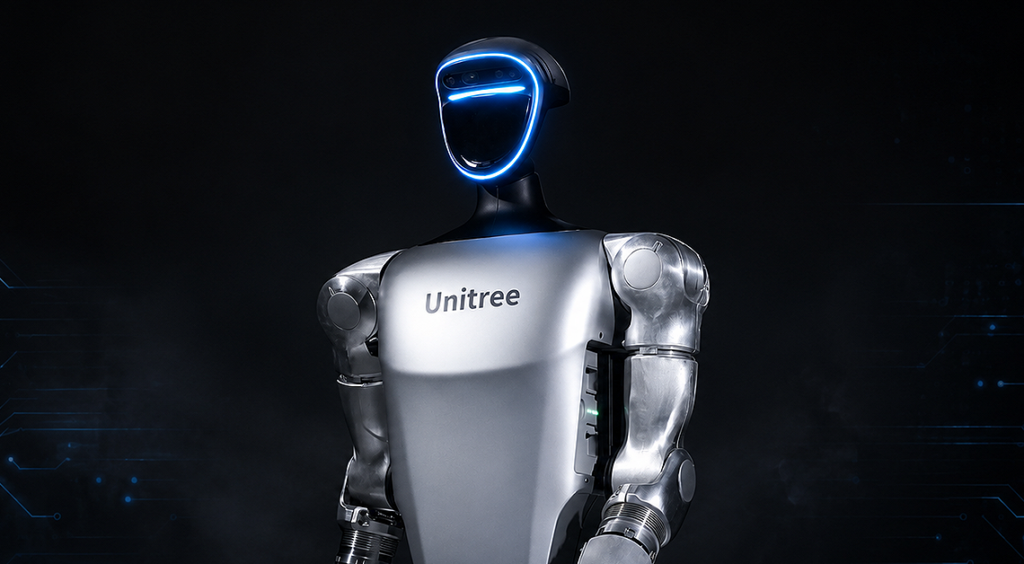
Nvidia on Monday unveiled its latest robotics research platform that will pair Unitree's nearly six-foot-tall H2 humanoid robot with Nvidia's Jetson Thor hardware powered by Blackwell GPUs. It also offers Nvidia’s two humanoid AI models, Isaac GR00T, as well as simulation software for robotics research and test environments.
In a conversation at an event in Taipei, Jensen Huang said the company created the platform for universities and researchers in higher education because it is nearly impossible to build such systems alone. The humanoid bot has 31 degrees of freedom and mechanical hands made by Sharpa in Singapore.
Unitree: Expanding Outside China Now Just As IPO Nears
This news follows reports that Unitree had been working towards a 4.2 billion yuan ($620 million) IPO on Shanghai's STAR board. The company was set to have its IPO application reviewed by the stock finder.
Unitree claims that over 40% of its revenues are already generated in markets outside China. The firm also revealed that from October, the improved H2 Plus humanoid robot would be made available for sale.
Humanoid System to be Used by Major Universities
At least four research institutions plan to use the new H2 Plus humanoid robot system, according to Nvidia. These consist of Stanford Robotics Centre, ETH Zurich, Seattle-based AI2 and the Advanced Robotics and Controls Laboratory at the University of California San Diego.
According to Nvidia executive Rev Lebaredian, the system is meant to democratise advanced humanoid robotics research beyond large tech firms and AI startups.
Nvidia Pivots Further Into Physical AI
Nvidia has been looking more and further into a focus on robotics, “physical AI,” being a key area of future growth. In the recent briefing with investors, Jensen Huang said that he expects robotics to have a rapid growth during the next five years and called physical AI up for tens of trillions of dollars worth market.
That new humanoid platform lends Nvidia robotics software and AI computing through its CUDA software ecosystem and AI-focused hardware products.
FAQs
- Who did Nvidia choose for the robot company?
Nvidia chose Unitree Robotics out of China to create its humanoid robot platform.
- What Robot is Nvidia Getting?
The System is run on Unitree's H2 Humanoid Robot.
- What hardware powers the robot?
The platform is equipped with Nvidia's Jetson Thor integrated circuits, which are optimised for use in self-driving vehicles and feature Blackwell GPUs.
- Is Unitree planning an IPO?
Yes, Unitree targets a 4.2 billion yuan listing in Shanghai
- What colleges will utilise the robot equipment?
The platform will be used by Stanford, ETH Zurich, AI2 and UC San Diego.
Follow Inspirepreneur Magazine for daily global business news

At Inspirepreneurs Magazine, covering entrepreneurship, business failures, and the human stories behind the world's most ambitious founders. She writes at the intersection of strategy and storytelling.
You Might Also Like

SoftBank Picks Top Banks for PayPay’s $2 Billion U.S. IPO Plan

Amazon Invests $500 Million in Nuclear Power to Fuel AI Expansion
