Anthropic Launches Claude Opus 5.5 at 40% Lower Cost
Synopsis
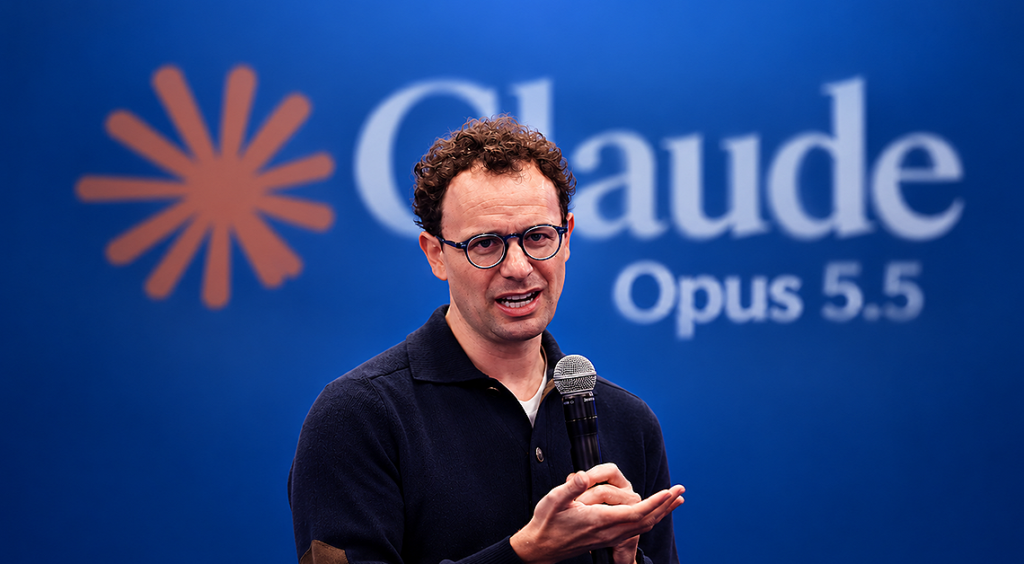
Anthropic has launched Claude Opus 5.5, its latest AI model, with 40% lower running costs and stronger safety measures.
Key Highlights
- Anthropic launches Claude 5.5 and continues to refine its latest AI.
- Opus 5.5 suggests it outperformed OpenAI’s GPT-5.
- The model is $4 per million input tokens and $20 per million output tokens
- Anthropic claims its new model sports more robust safety features and is accessible via AWS, Google Cloud as well as Microsoft Azure.
Anthropic launched Claude Opus 5.5 in an ever-competitive AI landscape that includes new models.
Opus 5.5 is said to deliver leading performance better than Fable 5.1, while costing 40% less to run than its predecessor, according to the company
The announcement arrives at a time when AI companies are under pressure to increase model performance while simultaneously exercising tight cost controls on operating complex systems.
Opus 5.5 Takes on GPT-5.6 Sol
Opus 5.5 outperformed OpenAI’s GPT-5 in tests, according to Anthropic. A software design benchmark with 6 Sol. The model is also said by the company to be about a third of the price to operate as GPT-5. 6 Sol on that benchmark.
Performance and cost work in a sort of pair that could prove meaningful to the competition between the leaders in AI models, with buyers likely drawn to using an artificial intelligence model for software development and other demanding tasks.
Anthropic Makes Its Newest Model Cheaper
According to Anthropic, prices for Opus 5.5 are $4 per million input tokens and $20 per million output tokens. The prices, the company said, are 20% lower than Opus 5.
The model is also offered through major cloud platforms, Amazon Web Services, Google Cloud & Microsoft Azure, providing businesses with additional options to access the technology.
Updated Model With Enhanced Safety Features
The launch also places significant emphasis on the safety of AI. Before launching Opus 5.5, Anthropic said it tested its safety with independent AI research firms Frontier Design and METR. The company said it also has safety features that were only used in its most advanced systems.
Opus 5.5 was approximately 85% less likely to attempt to evade containment boundaries during a special evaluation set aside for that type of prompt than Opus 5 or Mythos 5.1 in Anthropic’s internal safety evaluations.
This follows an appeal earlier this month from CEO Dario Amodei to the world AI community for a slower pace of release of new capabilities due to possible safety issues.
Upcoming Claude 5.5 Models
Claude Sonnet 5.5 and Claude Haiku 5.5 will be rolling out soon, Anthropic said in a release today. The company said those models will feature performance, speed and safety improvements. Anthropic is also expanding programs that offer approved cybersecurity and life-sciences researchers wider access to Opus 5.5.
What It Means for Australian Business and Entrepreneurs
Opus 5.5 gives complex AI customers throughout the world another decision for programming improvement and other interest workloads, including Australian organizations utilizing an Opus-empowered chip to power AI capacity flexibly, with far superior levels The price point could make the total cost of running state-of-the-art AI models a major consideration for companies buying different systems against one.
Australian companies also gain access through major cloud platforms, thanks to the model’s availability via AWS, Google Cloud and Microsoft Azure. As Anthropic progressively expands its offering within the Claude 5.5 family of models, there are different go-fast/big-save options available for businesses depending on performance, speed and scaling cost.
Source: Reuters

At Inspirepreneurs Magazine, covering entrepreneurship, business failures, and the human stories behind the world's most ambitious founders. She writes at the intersection of strategy and storytelling.