


How Redbubble Helped Independent Artists Reach Global Customers
Synopsis
From a simple idea in Melbourne to a global marketplace for independent artists, Redbubble's journey shows how technology and print-on-demand can create new opportunities for creators.
For artists, design is usually the easiest part. The challenge usually lies in encouraging people to purchase the end product. Costs of producing things like printing, manufacturing, storage and even finding your customers can be very high to handle alone.
The company Redbubble acknowledged this and built an innovative solution which eliminated the production responsibilities on artists.
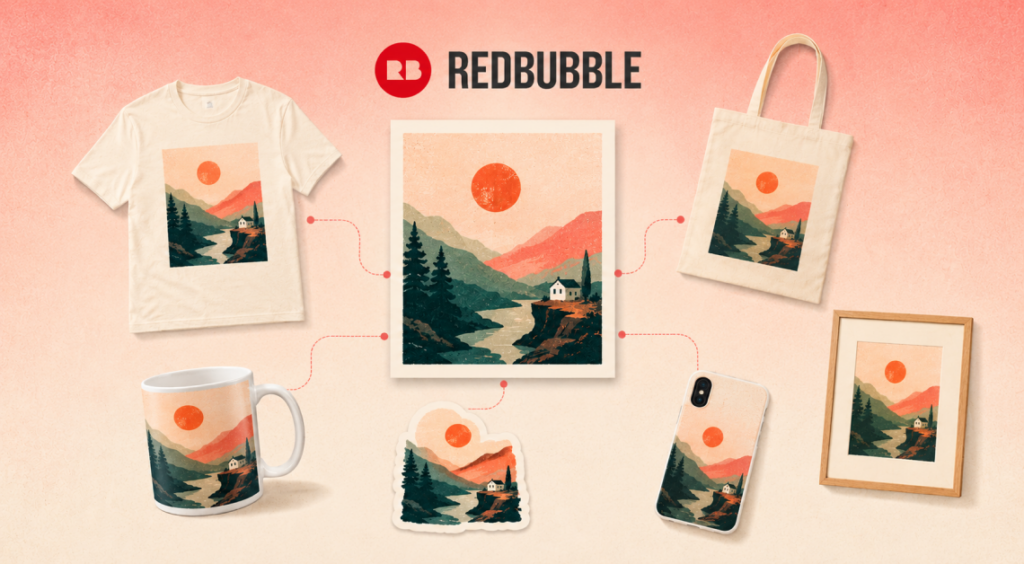
The company was built as a platform to allow artists like illustrators, photographers to upload their creations, have it printed on a requested day, and also allow customers who'd prefer the art as a physical commodity- buy it. It thus offered artists the chance to capitalize on the potential market without the need of stocking, producing, or shipping their own works.
At the time Redbubble appeared, it was groundbreaking- because other independent artists had few options to showcase and sell their art beyond face-to-face selling methods. The worldwide print-on-demand (POD) market size was valued at USD 11.38 billion in 2025, projected to reach USD 61.79 billion in 2021 and then further grow by a CAGR of 20.06 percent until 2034.
Launched as Redbubble in Melbourne, Australia in 2006. The business presented itself as a way to link artists with buyers of unique prints. The creators were encouraged to submit any illustrations, photography, graphics, and creative graphics that they had for sale on the website in exchange for a profit split. Use of print-on-demand manufacturing helped decrease prices.
The company eventually took their model a step further where they act as the middlemen between customers and artists, contracting with 3rd party manufacturing houses to produce the items. In 2017 the company had registered over 450,000 active users on their platform (artists), 11 million images and 7 million buyers.
This Case study thus proves that companies like Redbubble are built in response to the need of a specific market, identify the problem it is having and develop the technology necessary to meet the needs of their clients. Redbubble, having successfully traded for almost two decades of the growth and shifting trends of the POD business had the need to change and diversify its revenue stream to stay sustainable yet creative for their clients.
The Beginning of Redbubble
Redbubble was co-founded in 2006 by Martin Hosking, Peter Styles and Paul Vanzella. The original idea was actually around using print-on-demand technology for personalisation. However, the founders soon realised that the technology could be used for something much bigger.
Martin Hosking explained that the company eventually decided to use the technology exclusively to serve artists and help their creative work find a home. This became the foundation of Redbubble's business model and its philosophy of standing for artists.
Hosking also brought a different background to the company. He started his career as an Australian diplomat before moving into technology and the dotcom sector. He later became involved in several technology companies and helped build Redbubble into a global marketplace.
| Redbubble's Important Milestones | Year |
| Company founded in Melbourne | 2006 |
| Redbubble website launched | 2007 |
| Reached more than 450,000 active artists | 2017 |
| Acquired TeePublic | 2018 |
| Introduced artist account fees | 2023 |
| Combined Redbubble and TeePublic operations | 2024–25 |
Providing Independent Artists a New Medium to Sell
One of the biggest problems for independent artists was not necessarily a lack of creativity. It was the difficulty of converting that creativity into a business.
An artist could create an illustration, photograph or graphic design but producing thousands of products was expensive and risky. There was also the challenge of finding customers. Redbubble changed this by making the production process much simpler.
Artists can open a shop, upload their designs and place them on products without maintaining physical inventory. When a customer buys a product, it is produced and shipped through Redbubble's network of third-party producers. The company currently offers designs across more than 70 products.
This model also helped Redbubble build a marketplace where artists and customers benefited from each other. More artists meant more designs for customers while more customers created greater opportunities for artists.
Growing into a Global Marketplace
The idea behind Redbubble started in Melbourne but the company quickly developed a global audience. By 2017, the marketplace had more than 450,000 active artists, 11 million images and almost seven million buyers. Artists had earned almost $70 million through the marketplace during its first decade.
The company continued expanding its ecosystem and acquired TeePublic in 2018 that gave the group another marketplace focused strongly on apparel and creators. The acquisition later became an important part of the company's strategy.
| Redbubble’s Marketplace in FY25 | Result |
| Selling artists | 542,000 |
| Customers | 3.5 million |
| Designs sold | 3.6 million |
| Net artist earnings | $30.2 million |
| Revenue from contracts with customers | A$236.2 million |
Challenges in the Market
However, the growth of Redbubble has also brought new challenges. The print-on-demand industry has become increasingly competitive over the years while customers now have many platforms offering customised products. Higher production costs, quality control, delivery times and cross-border taxes remain some of the challenges faced by the industry.
Redbubble itself faced pressure in recent years. In FY25, its marketplace revenue declined 19 percent from the previous year. The company responded by improving its supply chain, marketing efficiency and cost structure. Its gross profit margin increased by 430 basis points to 47.1 percent.
The company also combined the operations of Redbubble and TeePublic. The leadership teams were combined in October 2024, supply chain operations in January 2025 and marketing teams in March 2025. The changes were aimed at reducing costs and improving efficiency.
Where Redbubble Stands Today
Today, Redbubble remains part of Articore Group which also operates TeePublic and other creator-focused platforms. Redbubble's community includes more than 700,000 artists and designers. Its current Group CEO is Vivek Kumar who joined the business in 2022 as CEO of TeePublic and became Group CEO in June 2025.
The company is now focusing on stabilising its revenue, improving margins, increasing marketing efficiency and using technology to improve its marketplaces.
The Way Ahead
Redbubble's journey shows how technology can solve a problem that existed for independent creators for years. The company did not simply create another online store. It created a marketplace where artists could focus on their creativity while the platform handled much of the production and distribution process.
The print-on-demand industry is still growing rapidly but competition is also increasing. Redbubble's future will depend on how effectively it can improve its customer experience, support valuable artists, control costs and adapt to changing technology.
The original idea behind the inception of Redbubble was to help independent artists sell their creations. Almost two decades later, that idea has developed into a global creator marketplace. Looking forward, the next challenge for Redbubble lies in turning that strong foundation into its next phase of growth.
Source:
Redbubble Official Website
Articore FY25 Annual Report and FY25 Results Investor Presentation
Martin Hosking’s Interviews and Company Posts
The Business Research Company
IMARC Group
Grand View Research

Vishal is an experienced Editor at Inspirepreneur Magazine with key interests in artificial intelligence, eCommerce, entrepreneurship, lifestyle and startup sector. Prior to joining Inspirepreneur, he was a Content Writer cum Correspondent at Siliconindia Magazine, where he worked on Company Profiles, Cover Stories, Executive Profiles, Feature Articles and Thought Leadership content.


