


Shoes of Prey: How $25 Million Fashion-Tech Startup Collapsed Into Liquidation
Synopsis
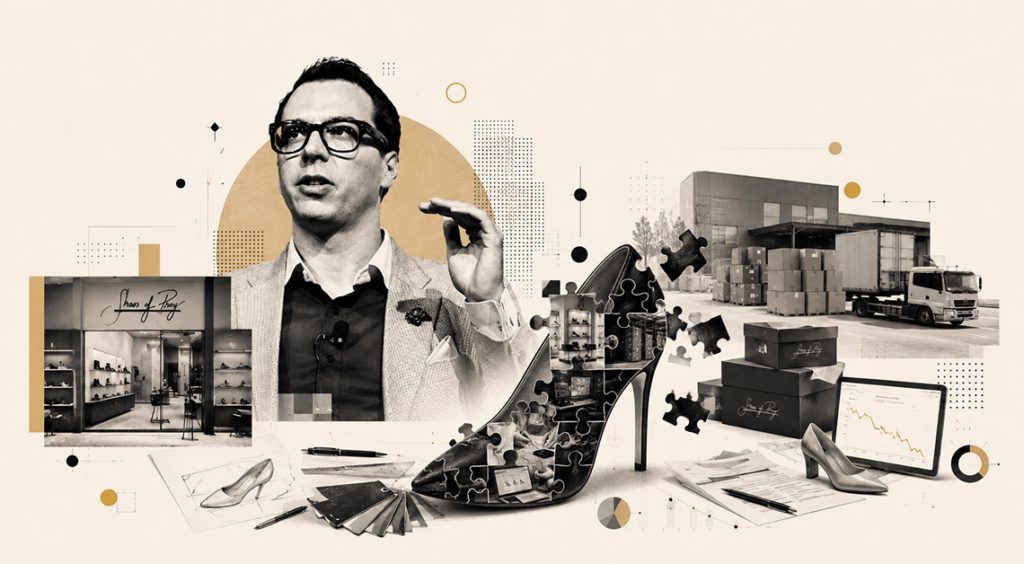
Shoes of Prey grew from a bootstrapped startup into one of Australia’s most high-profile fashion-tech companies, raising over US$25 million before its business model, rapid expansion and cash burn led to liquidation in 2019.
Shoes of Prey was once one of the greatest startup success stories in Australia. It enabled women to create their own shoes online, selecting heel height, fabric and colour options, and for a time seemed invincible. It raised more than $25 million from serious venture capital firms, collaborations with major retailers, and apparently $115 in sales in year one. Then in less than a year it all fell apart. This case study examines the building of Shoes of Prey, why this business model was not sustainable at scale and the reasons behind the liquidation in March 2019.
About The Founders
Shoes of Prey was founded in 2009 by Jodie Fox and her then-husband Michael Fox, along with Mike Knapp, a college friend of Jodie’s who previously worked at Google. None of the trio had any experience in retail or shoe production before launching the company. The concept itself was born almost by accident after Michael’s mum had returned from a holiday in Hong Kong raving about the customisable shoe shops she had seen there.
Michael worked on its strategy and Jodie was responsible for building the brand and leading its creative direction. Mike Knapp came from a tech background through Google, which influenced early decisions on how the company constructed its online design tools. When they were starting the company, all three went to Hong Kong to meet the suppliers who produced the brand's first shoes.
What set the founders apart was how in the beginning they kept things lean. Shoes of Prey was self funded and achieved cash flow break only 2 months after launching without the use of external capital. The company grew strictly by word of mouth and not through paid advertising, directly contributing to how attractive the story was for investors when it finally decided to raise capital a few years later.
The Idea And Early Growth
The company’s base shoe styles hold 12 types ranging from mules, ballet flats, pointed heels, and ankle booties launching (with customisable options for heel height, fabric and colour). Sizing was equally as flexible, with half sizes available from 2.5 to 15 and even the ability to have one shoe a different size to the other. This kind of specificity really sold a certain kind of consumer: women who actually liked making something that was like their own.
In its early years, nearly all growth was generated via word-of-mouth and PR; they had also gifted products to online personalities including YouTube star Blair Fowler. Come 2014, the firm had created over 4 million shoes and was reaching revenue figures in the multi-millions. The Sydney Morning Herald called it Australia’s highest profile startup in 2015 and by then it had secured partnerships with department store David Jones and US retailer Nordstrom.
The core scaling problem of the business
The whole of the business was designed around producing each individual pair of shoes, on demand for one customer. That meant the business was never able to harness the economies of scale that average shoemakers utilize to lower prices. Even for 10,000 custom pairs, the unit cost was not significantly lower than 10, each pair still needed a dedicated production run, quality verification and shipping.
Shoes of Prey opened its own factory in Southern China to shorten lead time and reduce cost. That offered the company greater control over turnaround but also involved absorbing the fixed costs of running a factory with nowhere near enough output to make that plant viable. And, regardless of how many shoes moved through the pipeline in a week, lots or few, fixed costs were always high.
Chasing The Mass Market
With some initial success and bolstered by investor confidence, Shoes of Prey wanted to demonstrate that even the mainstream shopper would be interested in designing their own shoes. The company raised $5.5 million in 2014 and $15.5 million in 2015 specifically to expand, with boutiques inside six Nordstrom stores across the US and David Jones in Australia along with e-commerce where it was already established.
Contrary to the research, mass-market customers had not reacted as they should have. Michael Fox later explained, normal shoppers didn’t want to spend time designing a product from the ground up. They want to see what was trending, what influencers and celebrities are already rocking, and buy that instead. According to Fox, in a phenomenon she dubbed decision paralysis, offering buyers too much customisation led them to become anxious by the options they faced instead of being motivated by them and conversion rates fell.
There were also costs associated with selling through Nordstrom that the company hadn’t entirely anticipated: in addition to rental costs for the boutique space in the store, Nordstrom charged commission and Shoes of Prey had to pay its own retail staff since regular Nordstrom staff sold on commission and had little incentive to walk a customer through a lengthy design process. In late 2016, those in-store boutiques were closed as they did not prove their cost.
The Retail Experiment And Cash Burn
Shoes of Prey was pressured to grow quickly, and so spent heavily on staff and marketing in its attempts to hit that growth target. Its workforce grew to roughly 200 people, who worked across design, manufacturing and retail. Costs consistently outstripped income, and as sales fumbled to run parallel with robust scaling of Mode’s footprint, the company’s cash ran dry quickly.
Following the closure of its retail boutiques, the company attempted to pivot into two adjacent spaces: catering to women requiring narrow or wide shoe sizes and producing short production runs for other brands and retailers. On paper, both ideas looked sensible, after all, most traditional Chinese shoe factories needed orders of at least 1,000 pairs and offered lead times up to three months in exchange for that level of production. Shoes of Prey could produce a single pair of shoes for delivery within two weeks. Neither pivot ever produced significant revenue at scale to cover the fixed costs of running the company, and losses were increasing in 2017 despite annual sales reported in that year nearing $115 million.
The Collapse And Liquidation
In 2018 Shoes of Prey relied on weekly revenue to not go bust. The firm retained investment bank Ohana & Co at the beginning of the year to pursue either a sale or refinancing. At one point, in August 2018, it stopped taking new orders completely, saying that it needed to take stock of its options. That pause turned permanent.
Shoes of Prey went into liquidation in March 2019 after it was unable to re capitalise the business or be sold, with FTI Consulting appointed as liquidator. Michael Fox said in a Medium post announcing the closure that things didn’t turn out the way they founders had hoped, but he stands by the experience as a whole. The call was made by Jodie Fox, who was in sole command and decided that liquidation at this stage was better than continuing the search for another move.
The Financial Toll
Over its lifetime Shoes of Prey raised over $25 million in venture capital, including a $5.5 million in 2014 and its largest round amounting to $15.5million in 2015, from investors such as Blue Sky Venture Capital, Greycroft and Nordstrom. Investors lost an estimated $36 million Australian dollars, or about $24 million US dollars when the company folded, effectively erasing the initial capital invested into the business.
It is this difference in scale that makes the numbers so black and white. The company was in liquidation less than 2 years later, having blown through its cash reserves faster than it could find revenue to replace it. The company that had ‘more than $115 million’ in annual sales. Michael Fox said later that if the company had remained aligned with its core niche audience instead of going after the mass market, it probably could have continued being a small, profitable business bringing in $20 million to $50 million a year.
Overall
The story of Shoes of Prey demonstrates how from the outside a business may appear to be doing just fine, boasting big sales figures and drawing in large-name investors, but on the inside running into a model that was never built to scale. The business had real early traction, a loyal niche of customers, and a very clear point of difference from the competition. However, chasing a mass audience that never actually asked for what it was offering, on top of an increasingly costlier (as opposed to becoming cheaper as it grows) manufacturing process, meant the business itself was fighting its foundations all through expansion. When the losses showed up in the numbers, there was no version of the plan that could save it.
What Came Next
Shoes of Prey had a collapse, but this was not the end for its founders. Indeed, Jodie Fox eventually moved on to build something new, applying what he had learned from this failure in an entirely different direction that achieved the success Shoes of Prey could not. To find out that story, click right here.

At Inspirepreneurs Magazine, covering entrepreneurship, business failures, and the human stories behind the world's most ambitious founders. She writes at the intersection of strategy and storytelling.
You Might Also Like
Toy factory crisis exposes new supply chain risk for retailers

Johnson & Johnson Launched onTrumpRx to Offer Discounted Meds
