Russia Ramps Up Assault on Ukraine Amid U.S. Withdrawal from Frontline Diplomacy
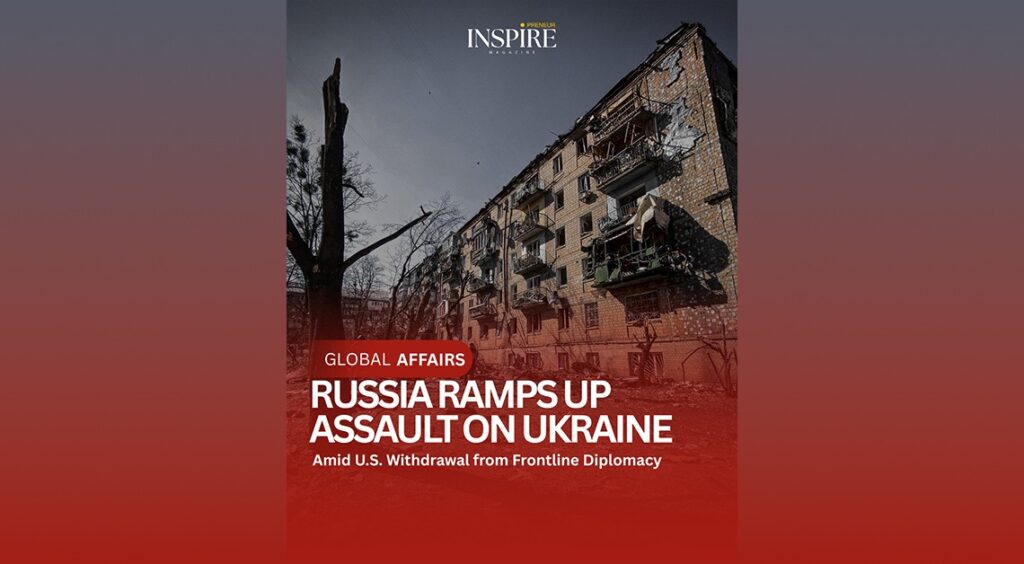
Kyiv endures the largest drone onslaught in months as Trump's policy shift stirs global concern
In a major escalation of its military campaign, Russia launched an extensive aerial attack on Ukraine early Monday, deploying a staggering 355 drones and at least nine missiles across multiple cities and regions. The strike marks one of the largest offensives in recent months, coming at a time when the United States appears to be retreating from its once-dominant diplomatic and military role in the conflict.
Ukrainian authorities confirmed that the overnight barrage resulted in widespread destruction, with civilian casualties reported and vital infrastructure damaged. Over the past week alone, Russia has unleashed more than 1,390 drones and 94 missiles, leaving over 30 civilians dead and injuring 163 others, according to Ukraine’s Air Force.
The timing of the escalation coincides with mounting uncertainty over Washington’s commitment to Kyiv. Former U.S. President Donald Trump, speaking to reporters on Sunday before boarding Air Force One, openly criticized Russian President Vladimir Putin for the violence, saying, “He’s killing a lot of people, and I don’t like it at all.” Yet Trump offered no indication of a policy shift or renewed military aid to Ukraine, leaving Kyiv increasingly isolated on the global stage.
Trump also sparked controversy by criticizing Ukrainian President Volodymyr Zelensky for what he called “provocative words,” further straining the narrative of U.S. support. “This is not Trump’s war,” he stated, signaling a withdrawal from active mediation and leaving many to question the future of American involvement in ending the war.
Russia Exploits the Diplomatic Void
Kremlin spokesman Dmitry Peskov expressed gratitude to Mr. Trump for facilitating earlier negotiations in Istanbul, calling it a “crucial moment.” However, analysts believe Moscow is now capitalizing on the absence of a strong Western counterbalance.
“For the last three years, Washington’s involvement has been critical in shaping the battlefield,” said Professor Phillips O’Brien of the University of St. Andrews. “Now, Ukraine is slowly being starved of the resources it needs, and Russia understands this shift all too well.”
No new U.S. weapons packages have been approved since Trump took office, and the $3.85 billion previously authorized by Congress remains untouched. With Patriot missile stockpiles running low, Ukraine’s defenses are weakening, leaving its skies increasingly vulnerable to Russian ballistic and drone assaults.
Evolving Threats and Tactical Challenges
Russia’s deployment of upgraded Iskander-M missiles, now equipped with radar decoys and erratic flight patterns, poses a new challenge to Ukraine’s interception systems. “These new missile trajectories make it nearly impossible to calculate interception points,” said Yurii Ihnat, spokesperson for the Ukrainian Air Force.
Meanwhile, the frontlines in eastern Ukraine are seeing renewed pressure, particularly in the corridor between Pokrovsk and Kostiantynivka in the Donetsk region. Military analysts believe these towns are critical to Russia’s ambitions of capturing the broader Donbas region.
Former Ukrainian military commander and current ambassador to the U.K., Valery Zaluzhny, painted a grim picture during a recent defense summit in Kyiv: “As long as Russia maintains its resources, it will continue these aggressive operations. There is no miracle coming to restore our borders. We must prepare for prolonged resistance.”
Looking Ahead: A Summer of Escalation?
While Ukraine has made strides in adapting its tactics, such as deploying agile drone units to stall Russian movements, Moscow’s manpower and weaponry remain formidable. “Russia retains a numerical advantage, and we expect pressure to mount this summer,” said Michael Kofman, senior fellow at the Carnegie Endowment for International Peace.
With U.S. policy drifting toward disengagement and European nations already stretched in their support, Kyiv faces a perilous path forward. The geopolitical implications are vast, raising urgent questions about the future of Western alliances, deterrence strategies, and the global response to authoritarian aggression.
Stay informed. Stay inspired. Subscribe to Inspirepreneur Magazine’s Newsletter for the latest developments on global conflicts, leadership insights, and strategic innovations shaping tomorrow’s world.

At Inspirepreneurs Magazine, covering entrepreneurship, business failures, and the human stories behind the world's most ambitious founders. She writes at the intersection of strategy and storytelling.