


What Is Vishing, and Why Is It Hitting Wall Street’s Biggest Firms?
Synopsis
AI-powered vishing attacks are becoming a major cybersecurity threat for financial firms. This article explains what vishing is, how AI voice cloning was used in coordinated attacks against leading Wall Street hedge funds, and why businesses must strengthen verification processes to defend against increasingly sophisticated social-engineering scams.
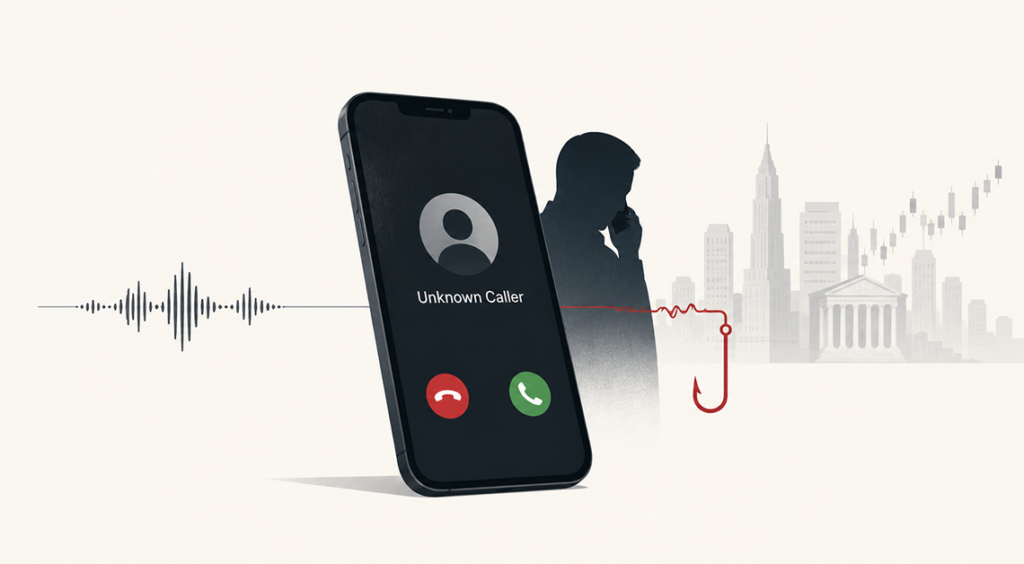
AI is changing how organizations work, but it is also changing how cybercriminals operate. In 2026, one of the fastest-growing dangers is vishing, which stands for voice phishing. It is a type of social engineering that involves using phone calls or voice messages to trick people into sharing confidential information or giving access to their systems.
Although vishing has been around, new developments in technology make it easier for this type of fraud to be successful. For instance, in August of 2026, a surge of AI-powered vishing attacks was directed at leading hedge funds of Wall Street such as Citadel, Point72 Asset Management, Two Sigma Investments, and Millennium Management. This case shows how technology allows cybercriminals to imitate managers to an extent that was previously hard to imagine.
Today, businesses and investors should be aware that the usual verification methods may be rendered useless against AI-generated voices.
What Is Vishing?
Vishing (voice phishing) is one of the types of cybercrimes. It is a technique of committing crimes with the help of voice communication.
Unlike traditional phishing emails, vishing is a type of crime that is committed over phones, voicemail messages, or other types of voice communication platforms. Attackers use this technique to impersonate people with a high level of trust to get vital information from workers.
In the past, vishing attacks required a lot of investment, as attackers had to sound believable enough to win their victims’ trust. However, the evolution of this technology due to AI has changed the situation radically.
Nowadays, criminals can have access to different kinds of audio using information from podcasts, video or audio interviews, earnings calls, webinars, and social media videos. Experts in the field say that AI makes it easy to produce synthetic voices that sound like real people based on just a few minutes of recorded audio messages
As a result, attackers can now impersonate executives and senior leaders at scale, making AI voice cloning cyberattack finance risks a growing concern across the financial sector.
How Do Wall Street Vishing Attacks Happen?
Media reports indicate that cybercriminals have used Artificial Intelligence technology designed to imitate the voices of executives of some companies and trick employees into sharing their passwords, acquiring access to systems, or conducting activities detrimental to the safety of the organization.
The companies in question include:
- Citadel
- Point72 Asset Management
- Two Sigma Investments
- Millennium Management
- Several unnamed private equity companies
The incident shows that the perpetrators of the attacks made use of advanced knowledge about the operations in the financial sector and relied predominantly on social engineering rather than technical weaknesses.
In the case of Two Sigma, it has been mentioned that the company has about $75 billion in assets under management, and that the security team was able to detect the attempted attack in time to avert any consequences.
In the case of Point72, the executives confirmed that the firm was not spared from an attack, but there is no evidence that client information was compromised.
Citadel and Millennium have not officially declared whether their companies’ attempts to defend against the attacks ended up being successful, and are unclear about the subject.
Why AI Voice Cloning Changes the Risk Landscape?
The incident that happened on Wall Street indicates the reason why several cyber specialists think that the usage of AI for social engineering leads to a great change in cyber risks.
Traditionally, fraud campaigns would involve a lot of human effort. Cybercriminals would thoroughly study victims, create messages addressed to them, and reach out to them one by one.
AI changed the game.
Instead of spending hours speaking like one executive, cybercriminals can synthesize voices and make hundreds or even thousands of calls in no time. The cost of the operation was reduced significantly, and the quality improved.
This change is worrying because humans easily trust voices.
Many companies put a lot of effort into creating protection from phishing e-mails or malicious links. Employees are trained to react to phishing e-mails. However, not many companies have implemented valid systems enabling them to check the trustworthiness of voice messages from top officials.
That is why AI social engineering finance sector is gaining significance among safety professionals and insurance companies.
Why Hedge Funds and Financial Firms Are Prime Targets
The reason why financial institutions are appealing targets for vishing from cybercriminals is due to combination of possessing lucrative assets and having sensitive data as well as being fast enough to take operational decisions.
Companies such as hedge funds, investment managers and private equity companies usually work with the following:
- Big financial transactions
- Confidential data of the customers
- Trade platforms
- Research on investments
- Market data
- Special access to financial accounts
In most cases, the employees should be fast in responding to calls from seniors. Hence, being fast in terms of activity is important, but it in turn leads to vulnerability to social engineering attacks.
A convincing phone call coming from a senior executive might be enough for an employee to skip the verification process, in particular during times of volatility.
The activation of the FINRA Financial Intelligence Fusion Center demonstrates how seriously the financial industry now views AI-enabled social engineering threats.
Why This Matters for Australian Financial Firms?
The consequences of the attacks have reached beyond America. However, they have left their mark both on the stock exchange and on various Australian organisations.
Most Australian banks and financial institutions work in a form that is similar to that of the US companies. Communication is done through secure channels, confidential customer data is handled with caution, and operational tasks are time-monitored.
The incident is also connected with the wider discussion of operational resilience, cyber governance, and identity verification.
Australian regulatory bodies, like ASIC and APRA, have been stressing the importance of cyber resilience and risk management in society. Though the Wall Street event has not produced any particular rule in Australia, it has underlined the necessity of finding ways to confirm the legitimacy of requests in the systems and their compliance with legal and proper standards.
Moreover, the issue has been raised for cyber insurance companies to think about. The insurers are currently discussing whether this type of fraud can be included in the general cyber cover or requires a separate clause of social engineering or crime coverage.
As the various types of AI fraud develop, the terms of cover will come under scrutiny.
How Businesses Can Protect Themselves Against Vishing
While technology is indeed involved in defending against vishing attacks, experts insist that it is process-based verification that is the best defense against the threat.
Here are some examples of how one can defend against vishing:
Use Out-of-Band Verification
If an employee gets a message asking for sensitive data such as personal data or money transfers, they should confirm with the caller through another communication channel.
This could mean hanging up the phone and calling the executive using a previously verified phone number instead of remaining on the line with the attacker.
Implement Multi-Person Approval Processes
Higher-risk actions should involve the approval of multiple authorized individuals.
This will decrease the risk of employees being duped into allowing attackers access or manipulated into transferring payments.
Establish Verification Protocols
An organization can use pre-agreed procedures such are usage of code words and secure messaging to verify that a caller is indeed who they say they are.
The employees should also know about AI-generated voice threats.
Train Employees on AI-Enabled Threats
Standard phishing training should be extended to cover AI-generated verbal strikes and manipulation methods.
Strengthen Access Controls
Regardless of how cybercriminals gain access to users’ details, effective authentication and limiting system access will minimize adverse results.
The Bottom Line
The attacks that took place in August 2026 targeting hedge funds on Wall Street reveal just how artificial intelligence has changed the nature of cybercrime. What used to be a relatively operationally limited hacking approach has turned into an expansive threat that can impact numerous companies at the same time using advanced voice-replicating technology.
From a business perspective, the major takeaway is that companies cannot rely on voice recognition alone anymore. AI-driven vishing has made the lines between real and fake communication more obscure.
With the constant advancement of the ability to replicate human voices using technology, companies across the globe should devote additional resources to improve their authentication processes, train their employees better, and reassess their approaches to the protection of highly sensitive data from social engineering attacks. The organizations that can successfully adapt to the new norm will remain ahead of the game and fight off future threats related to vishing.
FAQs
What is vishing?
Vishing meaning originates from the words “voice” and “phishing”. Vishing refers to the manner in which criminals contact potential victims via phone numbers associated with reliable persons. Just like in other phishing scams, vishing relies on engaging unsuspecting victims into giving sensitive information, remote access to systems, or sending money.
How does AI voice cloning make vishing more dangerous?
With AI voice cloning, criminals create synthetic voices that sound just like their target audience with little effort. This makes it easier for criminals to create voice messages coming from executives or colleagues.
Which Wall Street firms were targeted in the August 2026 vishing attacks?
Reports indicate that key hedge funds such as Citadel, Point72 Asset Management, Two Sigma Investments, and Millennium Management were targeted in the attack along with other companies engaged in private equity management. It is believed that criminals benefited from the AI-generated voices used for mimicking individuals in charge of operations in these financial organizations in order to obtain credentials and gain entry to the systems of target firms.
Which Wall Street firms were targeted in the August 2026 vishing attacks?
Financial organizations keep sensitive client data, important assets, and high-value transactions in their control. Moreover, the nature of the work performed in financial organizations creates a good environment for vishing attacks, as speedy requests from upper management are quite common in this area of business.

At Inspirepreneurs Magazine, covering entrepreneurship, business failures, and the human stories behind the world's most ambitious founders. She writes at the intersection of strategy and storytelling.
You Might Also Like

Bitcoin Treasury Firms Lose $62B as Crypto Rout Deepens

Australian and New Zealand Currencies Drop as Global Growth Outlook Weakens
