


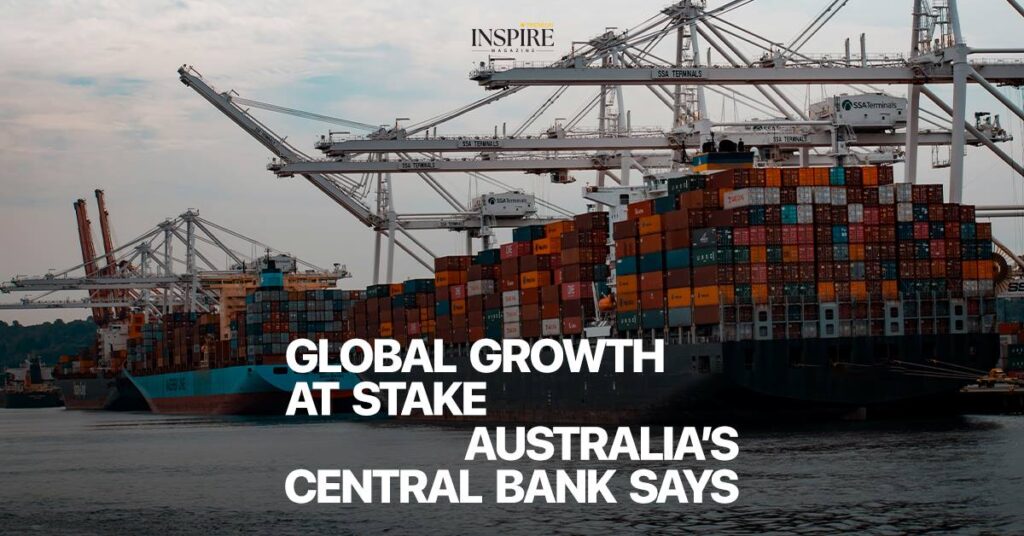
US Tariff Policies Could Threaten Global Growth, Warns Australia’s Central Bank
Synopsis
The Reserve Bank of Australia (RBA) has issued a stark warning about the risks posed by ongoing U.S. trade and tariff policies, emphasizing their potential to disrupt global economic stability. The bank's semi-annual Financial…
The Reserve Bank of Australia (RBA) has issued a stark warning about the risks posed by ongoing U.S. trade and tariff policies, emphasizing their potential to disrupt global economic stability. The bank's semi-annual Financial Stability Review highlighted growing concerns that such policies could prompt higher risk aversion in financial markets, elevate corporate financing costs, and dampen global business activity.
This warning comes amidst a global downturn in share prices, following U.S. President Donald Trump's recent announcement of tariffs ranging from 10% to much higher for certain trading partners. While Australia itself will face the baseline 10% tariffs, the true worry lies in how this could ripple across global markets, potentially threatening economic growth internationally.
The RBA's Concerns with US Tariff Policies
The RBA expressed deep concerns over the unpredictability of U.S. tariff policies and the escalating retaliatory measures from affected nations. The central bank outlined how these trade tensions could harm household and business confidence, resulting in reduced spending and slower economic activity.
Key concerns include:
Market Repricing Risks
- The RBA's report warns of the possibility that vulnerabilities in major global financial markets could lead to disorderly price adjustments. Such a scenario could cause a sharp rise in borrowing costs for corporations, particularly those outside the banking system.
Global Supply Chain Disruptions
The networked nature of global trade means that increased tariffs could harm supply chains, leading to costlier and slower production processes for businesses worldwide.
The RBA also highlighted that “ongoing uncertainty surrounding the imposition of tariffs and other trade restrictions... could have a chilling effect on business investment and household spending decisions”.
Impact on Australia's Trade Relationships
Australia may be among the least affected by the new U.S. tariffs, but the indirect effects could still weigh heavily on the country. The Reserve Bank pointed to mounting challenges in its largest export market, China, which faces tariffs as high as 54% under these new measures.
A slowdown in China's economy would further strain its financial system, intensifying weaknesses in its real estate sector. This fragile foundation could push Beijing to introduce additional policies to shore up growth, though this might extend existing debt issues within specific sectors of its economy.
For Australia, which is tightly connected to China’s economic fortunes, any sustained slowdown in China could translate into weaker demand for Australian goods, especially commodities like iron ore.
Domestic Economic Resilience
Within its Financial Stability Review, the RBA remained cautiously optimistic about Australia’s economic outlook. It observed that:
- Well-Capitalised Banks: Australian banks continue to maintain strong capital positions, a buffer against potential global financial shocks.
- Eased Household Financial Pressures: Lower inflation and falling interest rates have reduced financial strain for households, with fewer borrowers at risk of falling behind on loans, now down to 3% compared to a peak of 5% in prior quarters.
Nonetheless, the central bank flagged potential long-term risks, particularly those linked to housing affordability. Home prices hit record highs in March, spurred by February's interest rate cut. Over time, the RBA warned that easing financial conditions could encourage excessive borrowing, creating future vulnerabilities.
How US Tariff Policies Can Increase Costs for Businesses
US tariff policies do not merely impact direct trading countries but can also generate wider financial instability. The review emphasised how heightened tariff rates could prompt significant volatility:
- Corporate Borrowing Costs: Economic uncertainty and heightened risk aversion could mean a jump in interest rates for financing across global markets.
- Non-Bank Lending Vulnerability: The RBA noted that non-bank lending, often exposed to greater risk than traditional banking institutions, could face steeper challenges.
- Household and Consumer Sentiments: If cross-border retail costs increase, this could hold back global consumption, impacting revenue streams for export-heavy businesses worldwide.
Australia’s Policy Challenges Ahead
On the domestic policy front, the RBA has maintained its interest rate at 4.1%, following its February reduction. This stance reflects its cautious wait-and-see approach to stabilising the economy. Current expectations suggest a 70% likelihood of further rate cuts by May, with markets banking on a total reduction of 80 basis points across 2024.
The challenge for policymakers, however, is monitoring household debt and elevated home prices while ensuring inflation continues on a downward path. Regulators will also keep a watchful eye on any housing-related vulnerabilities stemming from growth in household lending.
Source
Reuters - Australia central bank warns US tariff policies
Explore more entrepreneurial insights and success stories at Inspirepreneur, your go-to magazine for business innovation and leadership.

At Inspirepreneurs Magazine, covering entrepreneurship, business failures, and the human stories behind the world's most ambitious founders. She writes at the intersection of strategy and storytelling.


