How Australia’s Cotton On Got Trapped Under 900 Stores and a $1 Million Retail Disaster
Synopsis
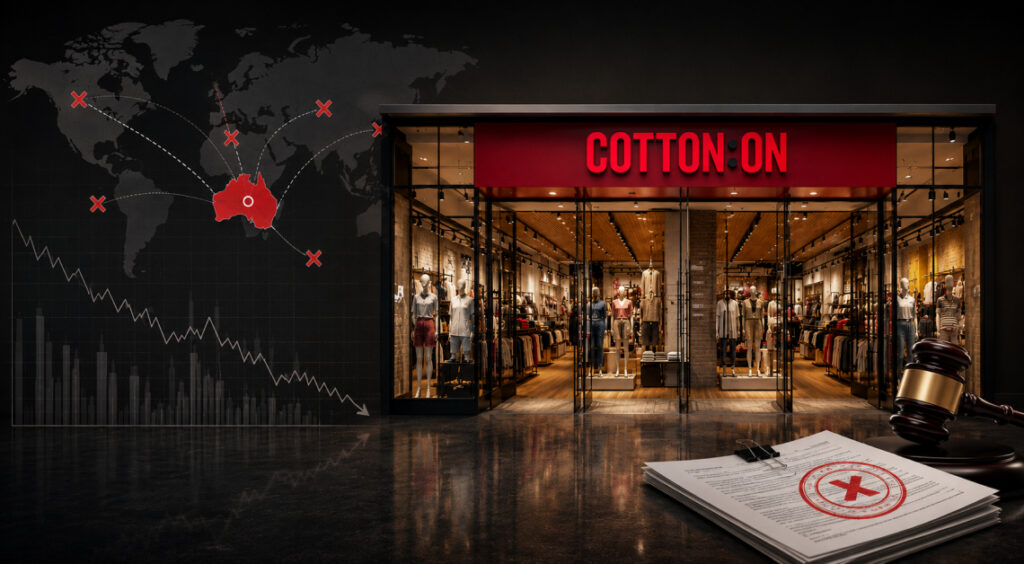
Australia’s Cotton On became one of the country’s biggest fast-fashion retailers through aggressive global expansion and rapid store growth. However, the company later faced slowing sales, failed international markets, rising retail costs, and a $1 million AUD regulatory penalty. Operating more than 900 physical stores during the rise of e-commerce created enormous pressure on the business. This case study explains how Cotton On became trapped inside a costly expansion strategy while online shopping transformed the global retail industry. The article explores the company’s biggest mistakes, failed markets, operational struggles, and lessons from its retail business failure.
Fashion businesses around the world were on an ambitious store-opening spree, expanding into foreign markets and pursuing high sales growth through the 2000s and early 2010s. Most retailers thought a bigger footprint means a bigger success.
This case study shows how a retail firm, Cotton On Group, one of Australia’s largest fashion retailers has found itself stuck in that very mindset. The company grew at a fast pace of expansion among shopping malls and global markets but did not respond rapidly to the growth in e-commerce markets and changes in Consumer behaviour.
The outcome was a tough business transition involving stalling growth, unsuccessful global markets, high costs of retail structure and a $1 million AUD fine for regulatory compliance. The tale of Cotton On turned into one of the cleanest examples of how fierce physical expansion can easily blow up in a row with high turnover.
About Cotton On
Cotton On Group is an Australian fast-fashion retailer that sells clothing, accessories, footwear and lifestyle products aimed at a young market. Starting in Geelong, Victoria, the company eventually became one of the most recognisable names in retail. Eventually, Cotton On grew beyond just one fashion label and created sub-brands catering to various customer segments. The business earned a reputation for rolling out stores quickly in shopping malls across Australia and overseas markets.
At its height, Cotton On serviced over 900 brick-and-mortar stores worldwide. It expanded into numerous countries and was flagged as one of Australia’s largest privately run fashion retail businesses. The growth strategy relied primarily on establishing additional retail locations and expanding physical market presence globally. The firm looked super successful for many years enjoying strong demand for fast fashion and heavy footfall at malls.
But beyond the breakneck growth, Cotton On was constructing a very heavy retail model that would soon become unsustainable when international shopping behaviours shifted.
About the Founder
Cotton On was started by Nigel Austin in 1991 with a small fashion idea in Victoria, Australia. According to the company history, Austin started selling denim jackets out of the trunk of his car before opening the first store.
The strategy was simple: to create chic fashions for youthful consumers on a budget. With the demand for cheap but stylish fashion surging in 1990s and 2000s, the concept quickly took off.
Austin then allowed the company to radically expand over the years, meaning Cotton On turned into one of Australia’s largest private retail businesses. The brand was clearly visible through several shopping centres and the affordable pricing helped garner a wider consumer base.
But, like so many retail founders during the fast-fashion surge, that caused the brand to get overly fixated on brick-and-mortar growth. Cotton On was building more stores around the world while the retail industry was slowly transitioning to digital commerce and online shopping. Its initial strategy, go first and worry about expansion later, turned into one of the organisation’s most serious business challenges.
How A Fast Fashion Boom Fueled Cotton On’s Blistering Expansion
Fast fashion was one of the fastest-growing sectors of world retailing during the late 2000s and early 2010s. Consumers sought fashionable clothing at lower prices, and retailers scrambled to deliver both fashion collections more quickly than ever before.
This was the period when shopping malls were expanding hand over fist. Australian and global urban marketplaces. With foot traffic in malls still relatively robust, retailers assumed that expanding brick and mortar stores was the surefire long-term path to success.
This trend helped Cotton On a lot. It grew aggressively from store to store throughout Australia and expanded into international markets. The visibility and sales growth were also supported by having new locations that purposely made the brand more visible and solid.
Now, the strategy seemed to thrive for years. Cotton On experienced two-digit growth and became one of the biggest non-public style retailers in Australia. Nevertheless, the company grew too much physically and not sufficiently in preparing for larger evolutions occurring within the retail marketplace.
Cotton On Reliant on Physical Stores
Cotton On also expanded its business model over this time, relying heavily on brick-and-mortar retailers. The retailer at one point had more than 900 stores worldwide, building up one of the largest physical retail empires of any Australian fashion brand.
This created enormous operating costs, but this expansion improved visibility. Every store needed a constant flow of money for rent, utilities, employee wages, restocking products, insurance, and maintenance. Such long-term commitments became very expensive over premium shopping centre locations. It wasn’t merely the number of stores that were the problem. The larger problem was that Cotton On became financially shackled to bricks-and-mortar retail at the very moment consumers were beginning to shift globally.
As the company grew larger, its physical footprint became bigger, and running the business began to become more expensive and complicated. Cotton On’s rapid expansion did not pave the way for flexibility, instead, it locked the business into a high-cost retail model that later came to threaten its very survival.
The E-Commerce Shift Reshaped Global Retail
Cotton On, meanwhile, remained retail-driven at a time when e-comm was virtualising the entire industry. In contrast, consumers reflected a growing preference for online shopping–on smartphones and laptops over spending time in malls.
Online fashion shopping provided more convenience, a lower level of difficulty in searching, door-to-door delivery and faster product comparison. Digital retail platforms began to take shape in the early 2010s, and younger shoppers especially started making that shift.
The digital-first fashion brands had moved fast with this change. With such low overheads compared to physical store chains, retailers, ASOS for instance, invested heavily in websites and delivery systems in addition to online logistics.
Cotton On reacted too slowly. Instead of making heavy investments into the digital systems early on, the organisation kept spending heavily on retail expansion and international store openings. Management had not fully grasped how fast online shopping was changing the industry by the time competitors with a digital-first background had already run up an insulation advantage.
Sales Growth Started Slowing
The first significant red flags came when Cotton On sales growth decelerated. Overall sales growth of the company fell to just 9% after years of rapid expansion and double-digit growth, while the Asia performance slowed to even lower at just 8.2%.
Those numbers may still sound good, even to most business owners. But that slowdown in growth, given the very nature of a fast-fashion retailer built on aggressive expansion, was alarming. Profit margins, in short, were extremely high where Cotton On had locked itself into leases for pricey retail bricks-and-mortar space internationally, labour obligations and extensive inventory systems across multiple countries.
The results presented here were able to sustain the large operating structure of the retailer but growth in sales was shrinking. Its operations had been too big to support at the current scale of the business. This era would be later pegged by retail analysts as a critical juncture because the company’s growth-at-all-costs approach was starting to reveal fatal cracks in its model.
The Numbers That Put Paid To Cotton On’s Retail Meltdown
The problems were already in view at Cotton On, whose physical retail network had become one of the largest among Australian fashion brands, when after many years of consistent growth it slipped sharply. The retailer’s total sales growth decelerated to 9%, well below the average double-digit expansion of recent years, while Asia-wide growth slowed further, down to 8.2%. For a fast-fashion company engineered to grow quickly, this data showed that the business was simply no longer growing nearly fast enough to keep up with its much more costly retail footprint.
Thanks to Cotton On’s overhead of more than 900 physical stores worldwide, the slowdown was hugely problematic. It was in the dark with huge commitments to malls, overseas personnel, warehousing and inventory processes, supply trains and logistics. However, until that point, income growth while at the same time beginning to moderate was high, while working expenses were high. That pressured profitability and revealed vulnerabilities in the company’s expansion-addicted business model.
As shopping moved online, Cotton On was saddled with one of the priciest retail footprints in its history. It had constructed a business model tailored for perpetual growth in brick-and-mortar fashion retail, set against an accelerating move toward digital commerce. Its expansive retail footprint, think of it as a competitive differentiator and moat, eventually turned into an albatross around its neck that added complexity and increased operational headwinds in every corner of the enterprise.
Markets collapse, store closures and a $1 million punch
Cotton On lost a similar amount of money through rampant global expansion without the long-term returns. A retailer then expanded into international markets to have a better global footprint but ultimately these regions lost sustainability at times. After having difficulties establishing sustainable growth in those nations, the business eventually exited or shut its doors altogether in Germany, Thailand, Saudi Arabia, Lebanon, Qatar and Jordan.
These closures were costly, because international expansion in retail involves considerable capital investment ahead of any revenue generation. Cotton On had also already invested in store development, recruitment, logistics systems, advertising campaigns, warehousing and local operations in those markets. Most of that investment was essentially written off as the company exited these countries, rendering its expansion strategy a big expensive flop.
Cotton On also hit the headlines with a massive regulatory issue, after Australia’s Federal Court found the retailer had been selling highly flammable nightwear for children that was falsely marked as being “low fire danger,” and fined it $1 million AUD during the same interval. The fallout eroded consumer confidence, generated bad press and led to inventory writedowns associated with the impacted products. Along with decelerating sales growth, increased operating costs and unsuccessful international meltdowns this fine came as a restless pressure point during one of the toughest times in the retailer’s textile history.
| Key Cotton On Failure Statistics | Figures |
| Global physical stores during expansion peak | 900+ stores |
| Overall sales growth slowdown | 9% |
| Asia sales growth slowdown | 8.2% |
| Federal Court regulatory penalty | $1 million AUD |
| Countries exited during failed expansion | 6 countries |
| Major failed markets | Germany, Thailand, Saudi Arabia, Lebanon, Qatar, Jordan |
The 900-Store Network Turned Into a Money Pit
The only massive financial strain on Cotton On was the fact that it operated more than 900 physical stores across the world. While large retail networks may provide better visibility, they also incur huge fixed costs that continue to accrue regardless of sales performance.
All Cotton On stores spent money on employees, power, stock control and upkeep as well as charges, insurance and rent. Customer flow within brick-and-mortar shopping malls began to slow as online shopping continued to spread around the world.
But Cotton On found itself bogged down with difficult leases in multiple countries. Because at the time, the company had built a really high-cost retail machine, while the rest of the world was heading toward low-cost online commerce. That has become one of the major vulnerabilities of the retailer. As Cotton On expanded its physical footprint, it became more expensive to run, not less so as a function of greater size.
This later became known among retail experts as a capital-heavy retail trap, whereby companies are caught under weighty, fixed operating costs even as the broader dynamics of the industry change.
Cotton On’s Failed International Expansion
As part of Cotton On’s international expansion attempts, the chain also stumbled on pricey errors. The retailer aimed to expand its international footprint into several markets aggressively. Yet most of these markets proved financially unviable.
Before its eventual exit, the company shuttered stores throughout Germany, Thailand, Saudi Arabia, Lebanon, Qatar and Jordan. These closures were stinging setbacks because these international retail endeavours require significant investment in staff, logistics, marketing, warehousing supply chains and local operations.
Since a lot of that investment in overseas markets ends up being an actual financial loss. Cotton On torched substantial cash going into countries it later had to abandon altogether. The botched, poorly-timed expansion revealed fatal weaknesses in the company’s international strategy and that the retailer had outpaced its operational systems just when they needed to be operating most safely and securely.
Cotton On moved too fast into tough markets rather than building sustainable international growth over many years.
Penalty of $1 Million by Regulator Damaged Brand Trust
At the same time, Cotton On hit a significant regulatory hurdle in Australia. In another case, a Federal Court penalised the company with $1 million AUD for selling very flammable nightwear for children inaccurately labelled as low fire danger. It reported about kids’ pyjamas and nightdresses which weren’t believed to comply with proper safety requirements. That incident turned into not only a financial but also a reputational issue for the company.
The problem also caused Cotton On to incur inventory write-offs, which weighed more heavily during a challenging time for business. This has made their move particularly damaging for a retailer focused on youth, whose customers need operations built around trust as well as product safety. The case also illustrated some of the risks of oversight in fast-fashion supply chains during rapid periods of expansion. With quick scaling across countries, ensuring uniformity in product standards is much harder on the operations side.
Cotton On’s Biggest Business Mistake
It was not one single decision that brought about the demise of Cotton On. It was a perfect storm for the company, with several high-risk strategies converging simultaneously. It expanded too fast, over-leaned on bricks-and-mortar locations, responded sluggishly to e-commerce, tackled challenging global markets and had burdensome operating expenses.
The retailer centred its business around a retail landscape that was shifting more rapidly than anticipated. Cotton On notes in its pitch AI strategy, The biggest strength of the business (the network of physical stores) has become one of our biggest weaknesses as purchasing behaviour moves online.
In the middle of the 2010s, the Aussie retailer had been shackled by its own strategy of expansion. The enormous global retail footprint, once its hallmark of success, had become one of the biggest operational headaches in the firm. Cotton On re-evaluated its whole business approach as a result but bounced back to success. Learn more about our success story of the turnaround journey of Cotton On, and how this Australian retailer rebounded from failure here.
Follow Inspirepreneur Magazine for daily global business news

At Inspirepreneurs Magazine, covering entrepreneurship, business failures, and the human stories behind the world's most ambitious founders. She writes at the intersection of strategy and storytelling.