


What Is a Business Development Company (BDC)?
Synopsis
Business Development Companies (BDCs) invest in and lend to smaller businesses while paying most of their earnings to shareholders, making them a popular income investment.
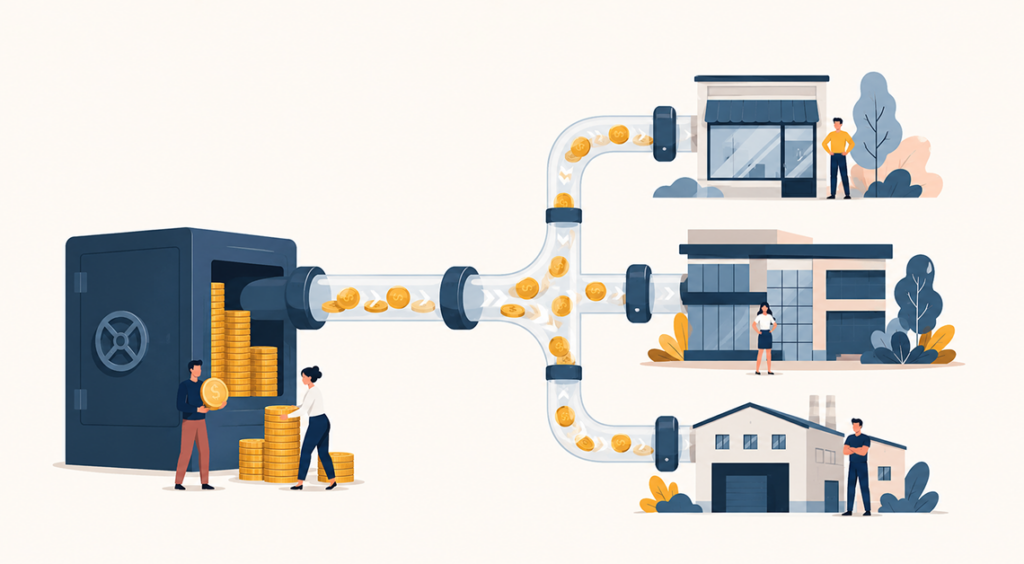
If you have looked for options to extract additional income from a portfolio, maybe the expression “business development company” or BDC is not new to you. That sounds a little techy but the idea is pretty simple. A BDC is a US-listed company whose business is lending money to (or investing in) smaller US companies that banks generally prefer not to deal with. In exchange, the BDC is required to pass through most of its profits directly to shareholders, which means these companies can usually pay some of the highest dividend yields in the business.
This part of the market has been largely a US story for years. Australians wanting in had to either open a US brokerage account, cope with foreign withholding tax and monitor currency movements. That’s changed. Muzinich BDC Income Fund (ASX: BDCI), has made ASX-listed options available that allow local investors to gain exposure to this asset class without ever crossing paths with an exchange in the US. This is what a BDC is, how it works, and what to be warned about when investing in one.
What Happened
BDCs aren’t new. Originally instituted by the US Congress in 1980, as an amendment to the Investment Company Act, they were designed to direct funds towards small and mid-cap American enterprises that could otherwise struggle to gain bank financing. The industry has matured to become a legitimate asset class since then. Data from financial reporting firm DFIN indicates that the amount of BDC assets under management rose about 38% year-on-year to approximately US$475 billion across a universe of over 150 individual BDCs at the start of Q1 2026.
For a company to be treated as a BDC under US law, it must hold at least 70% of its money invested in US businesses with less than US$250 million. And it also has to do more than just pass the cash, BDCs are obligated to provide some kind of managerial assistance or guidance support to the businesses they back, which is one thing that distinguishes them from a simple financing fund.
But this has not been directly accessible to Australians until recently. Well, that is now changing with local fund managers developing ASX-quoted products that use the US BDC market. As the underlining investment continues to be delivered through new avenues, Muzinich & Co can open up an avenue for everyday Australian investors by launching through Associate Global Partners a credit specialist firm based in New York that is going off shore has launched the on the ASX called Muzinich BDC Income Fund (BDCIs), as well aBali off shoreside indexers and product providers are launching local versions of their own funds.
Why It Matters
The reason income investors like you are attracted is very simple, yield. This is primarily because BDCs must pay out a minimum of 90% of their taxable income to shareholders as distributions by law, meaning they often dish out nightmares greater than that typically seen across the average ASX dividend stock. That income is from interest on loans to smaller US firms, many of which pay higher rates than blue-chip borrowers would.
There’s also an access argument. Due to high minimum investments, private equity and venture capital funds are usually only open to wealthy or institutional investors. But BDCs reverse that, being publicly traded, any retail investor can participate without needing specialised accounts or balance minimums and obtain a private-market-esque return profile in an everyday listed vehicle.
In other words, yield is not free. BDCs extend loans to smaller, riskier businesses, and many also borrow through debt themselves to enhance returns, usually no more than about double their equity. Moreover, distributions are typically taxed as ordinary income in Australia, not at the lower rate that applies to ASX-franked dividends authorisation label number one or capital gains registration number two so when viewing yields side by side, common sense prevails and a post-tax yield analysis should also be performed.
Big Picture
BDCs are straddling a much larger trend, the growth in private credit. So traditional banks have backed out of lending to the smaller businesses, and specialist lenders are doing more of that work so within the US BDCs are one of the big vehicles doing that. Latest numbers suggest that the sector is still growing strongly, with total BDC assets shrinking heavily while investors keep chasing yield beyond what conventional bonds and term deposits can offer.
And this is not limited to the US anymore. Australian fund managers are repackaging strategies previously only available to large institutions or US-based investors into products that trade on the ASX like any other share or ETF. One clear illustration of that change: the launch of BDCI; and more products in this area are likely to come as demand for alternative income increases.
What’s Next
Interest rates are the thing to watch most closely if you are considering this asset class. One big reason is that BDC income directly tracks the interest rates on the loans they own, which means as US rates go in one direction or another, so does the income pulled from these funds, the cost of debt borne by the businesses they financed.
More Australian product launches in this space seem a reasonable expectation with local fund managers keen to bring US private credit strategies to ASX investors in ETF or listed fund form. For the existing holder, and all that might move one step further, a more sensible question is to think not so much about the headline yield number but rather whether what you own remains viable/whether any of your funds will struggle at their next debt maturity or somewhere in between, for example, is the fund trading below its effective asset value.
FAQs
Can a non-US investor buy shares in US BDCs?
Yes. BDC shares can be purchased directly on the Nasdaq or NYSE via a broker with access to US markets although you would need to take into account US withholding tax and currency conversion. Instead, BDCI is a product that exposes investors to this same investment (US shares) but quoted on the ASX without needing to get an arrangement with a US brokerage account.
For Australian investorsWhat is the tax treatment of BDC dividends?
As BDC payouts are normally classified as ordinary income (not franked dividends), they do not provide the tax offsets offered by many ASX shares. Keep this in mind when comparing similar local dividend stocks on an after-tax basis.
How does a BDC actually differ in risk vs your standard ASX-listed company?
Unlike most ASX blue-chip stocks, BDCs take on credit risk and leverage as a part of their operations. Once small businesses to which a BDC has lent money start defaulting in more difficult economic conditions, both the income being passed through and the underlying value of the fund can fall sharply.

At Inspirepreneurs Magazine, covering entrepreneurship, business failures, and the human stories behind the world's most ambitious founders. She writes at the intersection of strategy and storytelling.
You Might Also Like

ASX Set to Rise Tuesday as Wall Street Hits Fresh Record

The Role of Google Maps in Revolutionizing Global Navigation and Local SEO
