


From Administration to Online Store: The Godfreys Reboot
Synopsis
Godfreys closed all its stores in 2024 but made a surprising comeback as an online-only business, giving Australia’s iconic vacuum retailer a second chance after administration.
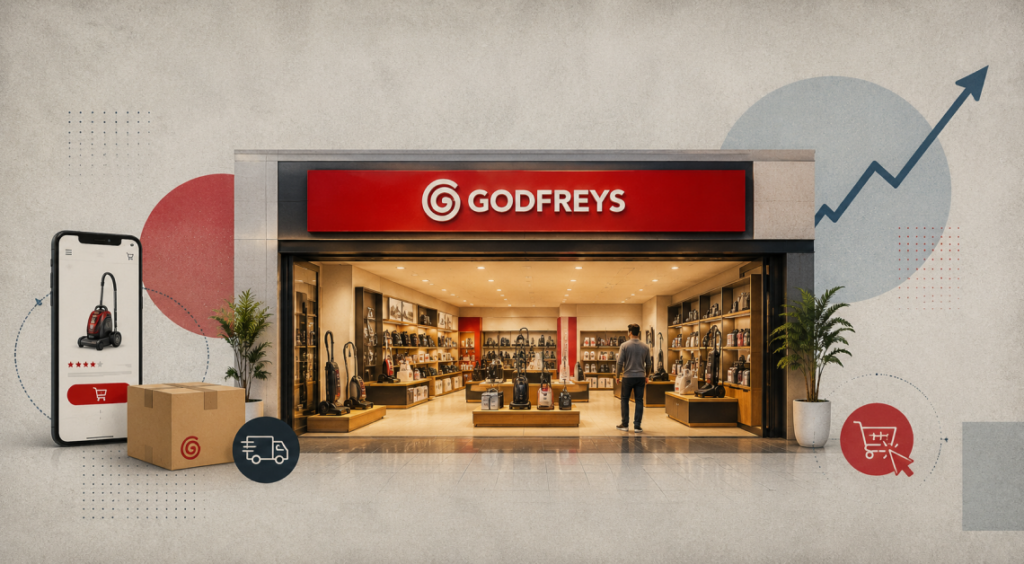
In May 2024, Godfreys closed all of its 141 stores, marking an end for a brand that had been part of Australian households since 1931. That would be seen by almost all as the end of it. However, the Godfreys name was back only seven months later - and this time with no stores at all. It is the tale of a defunct high street retailer that came back to life as an online entity.
A New Owner Steps In
Just a month after it unveiled the closure of the final Godfreys store, company Future Innovation Holdings purchased the Godfreys and Godfreys Commercial brands and their assets. It was not a case of rescuing the old firm. Gone for good were the stores, the leases and the franchise network. What the new owner acquired was just a brand name, trademarks and rights to products that Godfreys used to sell.
Future Innovation Holdings took its time with the relaunch. For the second half of 2024, it slowly rebuilt the business as an cake shop behind closed doors. Instead of promising something and then another failed sale for past customers, the company waited until it could actually sell the product again instead of telling us what to expect.
The Relaunch
In December 2024 Godfreys announced its relaunch on LinkedIn and social media with the slogan: ‘Who said Godfreys was closed for good! Godfreys is coming back, baby.” Launched in January 2025, the new site was entirely designed for online sales and B2B wholesale orders with no physical shopfronts on its agenda at all.
It also reintroduced familiar names to Godfreys regular customers in the relaunch, such as Wertheim, Pullman, Sauber and I-Vac and Work Hero. These were the same exclusive brands that had allowed Godfreys to differentiate from general retailers for years, now being sold online rather than over a shop counter. The plan was an easy one: preserve the brand name that took 90-plus years to engrain while sloughing off a store chain that had gotten too expensive to maintain.
In addition to the consumer site, the new owners also pushed aggressively into commercial cleaning supplies, selling equipment not just to individual shoppers but to businesses. This wholesale side provided Godfreys with a second revenue stream that relied not on walk-in customers at all, something the old store-based business had never enjoyed at this scale before.
Losing The Pounds That Downgraded It
The entire focus of the new model was to eliminate the costs that had destroyed the old model. Having 141 stores meant paying rent and wages [Wage bill] and utility bills at every single location even if the volume was negative or insignificant in that month. An online store has none of that. You do not pay any shopfront rent, staff roster in store and hence there is no franchise network to run or manage.
From a business perspective, this is an easy trade. On an individual store level, the old Godfreys made profit per customer but incurred fixed costs everywhere; it was a high break-even model whether customers walked in or not. The new Godfreys generates profits for each order taken online, with associated costs tracking up and down nearer to the real thing. Simply that differential alone eradicates the very issue that took the original business into administration.
The commercial wholesale side provides yet another buffer. Bulk sales to businesses tend to result in more stable, larger orders compared with single customers purchasing one vacuum cleaner at a time, making the dealer’s income less dependent on day-to-day consumers and smoothing out some of the ebbs and flows.
New Zealand Left Behind
The comeback extended no further than across the Tasman Sea. Kevin Healey, Godfreys Commercial’s business development manager, said Future Innovation Holdings would not buy Godfreys back to New Zealand again for now. Under old Godfreys, New Zealand had 16 company stores and 9 franchisee stores, which all closed at the same time as the Australian stores in 2024.
To date, the relaunched Godfreys runs solely in Australia, servicing home to customer and business through its website. It also allowed for the new company to be smaller and tighter, limiting it to one-nation stores, rather than a two-country network, permitting owners to concentrate time and money on just one market versus two.
As for whether Godfreys will eventually return to New Zealand, that remains a question mark as things stand now, the brand's next chapter is an Australia-only story based around a much smaller footprint than its predecessor.
Part of a Bigger Pattern
Another famous Australian brand to leave the shopping strips and return online is Godfreys. Other retailers such as Dick Smith and Pumpkin Patch collapsed as bricks-and-mortar businesses and then reopened under new ownership, with management taking a pure-play e-commerce approach. In these instances, buyers are not winding up purchasing a company. They are essentially buying a brand name that exists but is not widely known and trusted, then recreating a more stripped-down business behind that branding.

At Inspirepreneurs Magazine, covering entrepreneurship, business failures, and the human stories behind the world's most ambitious founders. She writes at the intersection of strategy and storytelling.
You Might Also Like

Sydney Scientists Break World Record with Revolutionary Solar Cell Technology

US Treasury rout tests Washington’s limits on rising borrowing costs
