


Humanoid Robots & Nvidia-LG Partnership
Synopsis
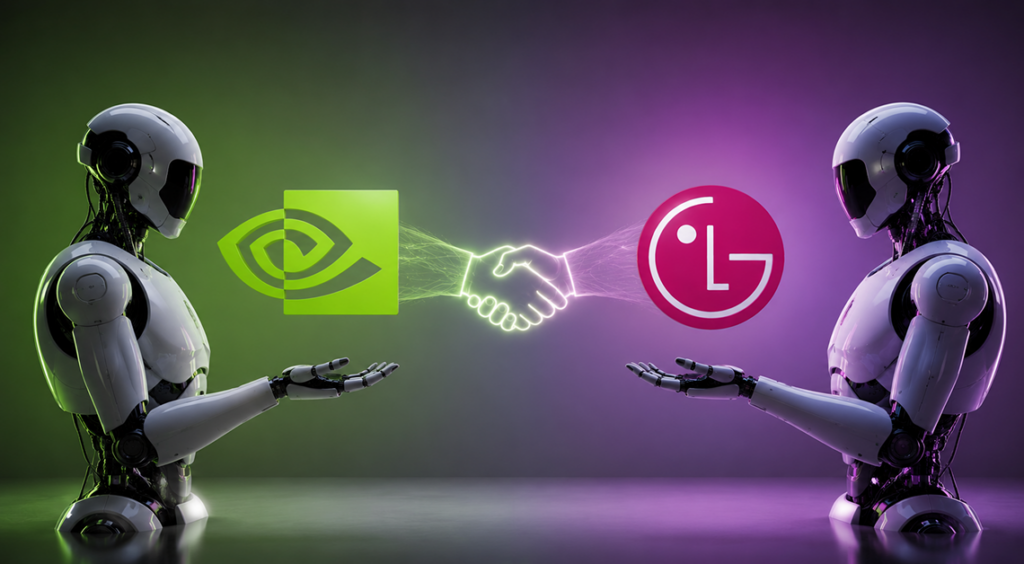
Nvidia and LG have partnered to accelerate humanoid robot development, combining AI, robotics and advanced computing technologies to expand automation capabilities across manufacturing, commercial and future consumer applications.
For years, "AI hardware" basically meant one thing: GPUs sitting in a data centre somewhere, crunching numbers for chatbots and recommendation engines. That's still a massive part of the story, but recent moves out of Seoul suggest the next chapter looks very different, and involves robots that can actually walk around and do physical work.
On June 8, Nvidia CEO Jensen Huang sat down with LG Group Chairman Koo Kwang-mo to discuss a collaboration spanning humanoid robots, autonomous driving, and the design of next-generation data centres. It's the kind of story that could easily get buried under the daily flood of AI news, but look closely at what's actually on the table, and it points to something bigger than a single deal.
What's Actually Being Discussed
Strip away the headlines and there are a few concrete pieces here. On the robotics side, Nvidia and LG are looking at co-developing motor technology and mechanical systems for humanoid robots, with Nvidia bringing its Isaac Sim and Isaac Lab platforms to the table, the simulation tools that let engineers test how a robot will move and behave before building the physical hardware.
It's worth being precise about where things stand. According to Bloomberg's reporting, LG has confirmed it's "exploring a strategic collaboration in physical AI" with Nvidia, including the robotics ecosystem, rather than a fully signed and sealed agreement.
LG isn't coming to the table empty-handed either. LG Electronics has already been deploying service robots through its CLOi platform in hotels, restaurants and retail settings for years, so any collaboration builds on something real rather than starting from a blank page.
Then there's the data centre piece, which might end up being the bigger story long-term. The discussions also cover the architectural design of future data centres, including cooling systems and power delivery, alongside GPU cloud services and autonomous driving technology.
Why "Physical AI" Keeps Coming Up
Nvidia has been using the term "physical AI" a lot lately, and it's worth understanding what it actually means. It refers to AI systems that operate in real-world environments rather than purely digital ones, think robots, self-driving cars, and factory equipment, as opposed to a model that just answers questions in a chat window.
For Nvidia, this represents a genuinely significant shift. Physical AI expands the company's addressable market well beyond selling GPUs to cloud providers, and a deeper relationship with LG would be a concrete step toward getting Nvidia's software and hardware stack embedded directly into robots, vehicles and factories.
Why Seoul, Specifically
The choice of location wasn't an accident. South Korea is one of the most robotics-dense countries in the world by industrial robot installations per capita, and its government has been pouring money into AI and automation initiatives. Huang travelling there personally is a fairly strong signal of how seriously Nvidia views the market.
It's also not an isolated relationship. Nvidia is working with companies to make their system better. They already work with Samsung and SK hynix. Now they might work with LG too. This means Nvidia is making friends with all the tech companies in Korea. They are not just trying to make one announcement, they want to build strong relationships .
The Supply Chain Story Nobody's Talking About
Here's where things get genuinely interesting, and it's a story that hasn't had much airtime in Australia. According to data compiled by Bloomberg, Asian suppliers now represent roughly 90% of Nvidia's production costs, up sharply from about 65% a year earlier. That figure covers Nvidia's established data centre supply chain, TSMC fabrication, SK hynix and Samsung for high-bandwidth memory, and server assembly from Foxconn and Quanta.
What's changing now is that Nvidia's physical AI hardware is adding entirely new product categories that route through those same suppliers. The company's robotics platform, Jetson Thor, launched last August and is built on the Blackwell GPU architecture, fabricated on TSMC's 3nm process. The top-end T5000 module delivers 2,070 FP4 TFLOPS with 128GB of memory, while a cheaper T4000 variant unveiled at CES 2026 offers 1,200 FP4 TFLOPS with 64GB at $1,999 per unit in volume, with both using memory sourced from Samsung or SK hynix.
The practical effect is that these robotics chips now compete for the same TSMC 3nm wafer capacity as Blackwell data centre GPUs, at a time when that capacity is already stretched thin. It's even affecting Nvidia's older product lines: memory shortages have forced Nvidia to accelerate end-of-life timelines for its older Jetson TX2 and Xavier modules, pushing customers onto newer Orin or Thor modules that draw from the same constrained Asian memory supply.
For anyone watching the vertical integration angle, this matters. Cooling and power delivery aren't just engineering details, they're the actual bottleneck on how many GPUs can fit into a single facility. If Nvidia helps design data centres specifically optimised around its own hardware, while simultaneously deepening its grip on the component supply chain that feeds everything from data centre GPUs to robot brains, that's a level of integration that becomes very difficult for competitors, or customers, to route around.
The Bigger Trend This Fits Into
If this all sounds like a single tech story, it's actually part of a much broader pattern playing out globally. Forrester's first dedicated report on humanoid robots found that 2026 marks a turning point for the category, with humanoid robots moving from speculative R&D into early commercial reality, driven partly by advances in generative AI and multimodal models that give robots better perception, reasoning, and the ability to generalise across different tasks.
The appetite from businesses is already there. Forrester's Automation Survey 2025 shows that 69% of automation leaders are either using humanoid robots or planning to do so. It also reflects early trials showing up in factories, warehouses, hospitals and customer facing businesses.
In fact, results have started showing up in real operational gains: companies are reporting 40% reductions in processing errors and 20% decreases in labor costs when humanoid robots take over repetitive, high-friction workflows, for example - BMW using humanoids for ergonomically difficult assembly tasks and KEENON Robotics cutting restaurant labor costs by 20% through automated food prep and cleaning.
What to Watch Next
A few things will tell us whether the Nvidia-LG talks turn into something concrete. The most obvious is whether this moves from "exploring a strategic collaboration" to an announced, formal partnership with specific commitments. It's also worth watching how Jetson Thor adoption plays out among Korean manufacturers, particularly given partners like Boston Dynamics and Amazon Robotics are already building on the platform.
There's also the supply chain question hanging over all of this. Nvidia has pledged up to $500 billion for US-based server manufacturing with Foxconn and Wistron, while Amkor and SPIL are building advanced chip-packaging plants in Arizona. But those facilities are still ramping up, not operating at full scale.
At the same time, Nvidia’s push into physical AI ,including robotics and autonomous systems — is increasing its need for components that are still largely made in Asia. How quickly US capacity catches up will determine just how reliant the AI hardware industry remains on a small group of Asian suppliers.
Either way, the direction is becoming harder to ignore. AI is no longer just something that happens inside a data centre, it's increasingly something that's going to walk into the room, and the supply chains behind it are getting more tangled, not less.
FAQs
Is the Nvidia-LG humanoid robot partnership confirmed?
Not fully. LG has confirmed it's "exploring a strategic collaboration in physical AI" with Nvidia, including the robotics ecosystem, but as of the meeting in Seoul, this remains in discussion rather than a signed, finalised deal.
What is Nvidia's Jetson Thor platform?
It's Nvidia's robotics computing platform, built on the Blackwell GPU architecture and fabricated on TSMC's 3nm process, with a top-end module delivering 2,070 FP4 TFLOPS and a lower-cost variant offering 1,200 FP4 TFLOPS at $1,999 per unit in volume.
How exposed is Nvidia to Asian supply chains?
Heavily, and increasingly so. Asian suppliers now account for roughly 90% of Nvidia's production costs, up from about 65% a year earlier, covering chip fabrication, memory, and server assembly.
How many businesses are adopting humanoid robots?
According to Forrester's Automation Survey 2025, 69% of automation decision-makers are adopting or planning to adopt humanoid robots, with early use already underway in manufacturing, logistics, healthcare and customer service.
Follow Inspirepreneur Magazine for more such explainers.

At Inspirepreneurs Magazine, covering entrepreneurship, business failures, and the human stories behind the world's most ambitious founders. She writes at the intersection of strategy and storytelling.


