


Virgin Australia’s ChatGPT launch highlights growing AI race in aviation
Synopsis
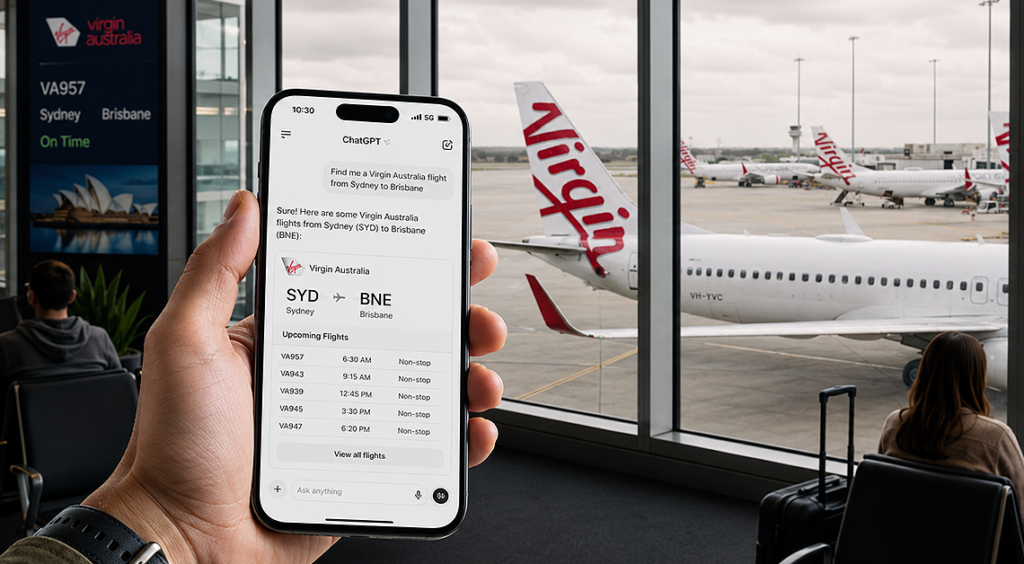
Virgin Australia has introduced flight search within ChatGPT, allowing travellers to find fares and reward seats using conversational prompts. The launch reflects a growing push by airlines to integrate generative AI into customer-facing services as global travel demand and digital engagement continue to rise.
Virgin Australia creates history in the Australian aviation by allowing customers to search flights via the integrated chat. This new chapter in the airline’s utilisation of generative AI technology to customer facing services is very exciting for the airline.
This move will enable customers to search for Virgin Australia flights via a range of natural language prompts instead of applying filters on a booking site.
These include but are not limited to, asking ChatGPT for the best priced flights for a certain route within a given budget, or finding out which date would be cheapest and then checking if there were any Velocity Frequent Flyer reward seats available before proceeding to book.
The rollout is the first step following Virgin Australia’s announcement in late 2025 of its strategic partnership with OpenAI. The move comes at a time when airlines around the world are seeking innovative ways to simplify booking for customers in order to eliminate friction from the travel planning process.
AI Edges Towards the Point of Sale
While airlines have long used AI for behind-the-scenes operations such as planning schedules and customer service, the current round of investment focuses on applications designed to facilitate customer interaction and simplify the process of booking flights.
Virgin Australia's new feature allows customers to enter flight queries into the chat system as they would with the natural language tool and then gives an answer based on criteria given in the query; allowing complex trip planning to be addressed by a conversational system, rather than through many different booking screen selections.
The development follows the increasing adoption of AI tools by consumers, indicated by a study from OpenAI finding the use of the program to be soaring within Australia and, consequently, many businesses of varied industries beginning to invest in new AI tools for the purpose of optimizing their own search and recommendation systems.
Industry Increasing Focus on AI
Strong demand for flights is set to continue to boom in the airline industry, with the IATA reporting it expects to carry over five billion passengers by 2026, generating revenue in excess of US$1.1 trillion. Airlines will find themselves under significant pressure to enhance customer experience, but must do so without major increases to operating costs.
With that in mind, it has become clear that technologies capable of streamlining booking and frequent flyer searches are of particular interest within the US, Europe and the Asia-Pacific regions, and this recent development from Virgin Australia shows that Australia is not falling behind these trends.
This new tool places Virgin Australia squarely within these expanding global interests, particularly with regards to adopting AI not as a replacement for the traditional reservation system, but as a complementary feature.
While the potential long-term commercial benefit has yet to be revealed, the launch suggests that AI is no longer restricted to the area of customer service and will soon become a significant feature in many parts of the customer travel journey.
FAQs
Q1. How does Virgin Australia’s ChatGPT search differ from traditional flight search tools?
It interprets free‑form natural‑language queries and returns filtered results in seconds, eliminating the need for precise keyword inputs.
Q2. Which regulations does the new feature meet?
The system complies with the Australian Privacy Act 1988 and Australian Consumer Law requirements for transparent pricing and data handling.
Q3. Can other airlines adopt the same technology with minimal code changes?
Yes, Virgin’s integration used a thin wrapper around existing APIs, allowing similar carriers to replicate the approach with modest development effort.
Q4. What immediate operational benefit did Virgin observe?
Early tests recorded a 20% cut in search duration and an 8% drop in booking‑page bounce rates, freeing staff for higher‑value tasks.
Source: The West
Follow Inspirepreneur Magazine for daily global business news.

Pooja Malik is a business journalist with over six years of experience covering startups, entrepreneurship, and emerging trends. She has previously worked with leading media platforms such as YourStory Media and BW BusinessWorld, where she reported on business, policy, and market developments. Currently, she serves as Editor at The Inspirepreneur Magazine, where she writes and edits stories across business, lifestyle, and travel, with a focus on clarity, accuracy, and reader relevance.
You Might Also Like

Australia Enacts Historic Treaty With Indigenous People

GST 2.0 Brings Major Price Cuts Across India During Festival Season
