


From Truffles to Seaweed: Australia No Longer Riding on the Sheep’s Back
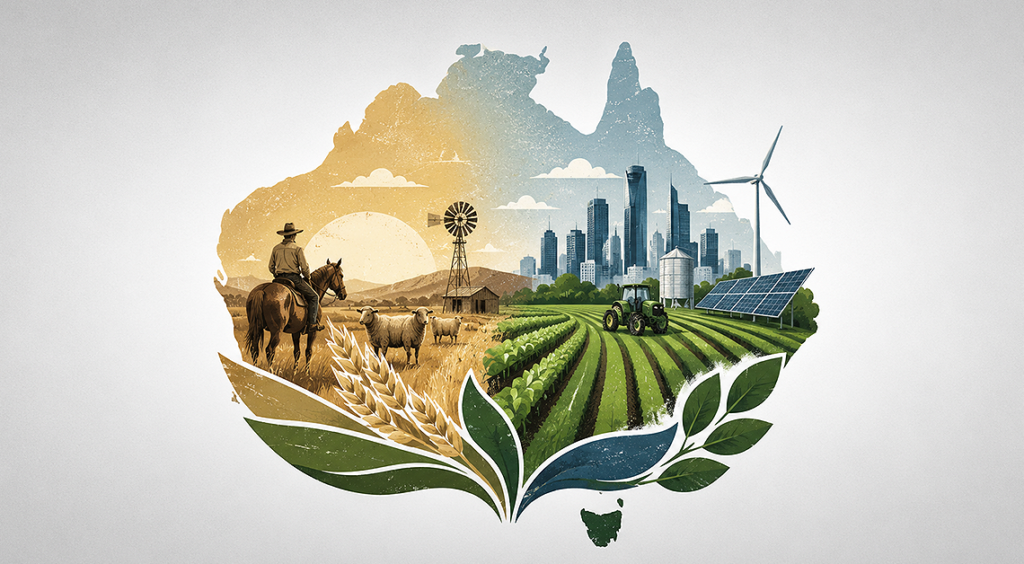
From saffron in Victoria to truffles in WA and seaweed off the SA coast, discover how Australian farmers are moving away from traditional crops and finding new global markets.
For generations, Australian agriculture was defined by wheat, wool, and cattle. The nation effectively “rode on the sheep’s back” for roughly a century, a period of national prosperity driven by wool exports that stretched from the 1880s through to the 1970s, delivering one of the highest standards of living in the world.
At its peak, wool accounted for more than 50 per cent of the total value of all Australian agricultural production. Then came a series of devastating price crashes, prolonged droughts, and the rise of synthetic fibres, causing the sector’s economic dominance to fade . The national sheep flock, which had reached an all-time peak of around 180 million in the early 1970s, shrank significantly as global markets shifted and competition intensified.
Today, Australian agricultural export trends rely heavily on other sectors, though premium wool, prime lamb, and beef remain important contributors to the rural economy. But a more profound transformation is underway one driven by climate change, shifting consumer preferences, and entrepreneurial necessity. According to the Australian Bureau of Agricultural and Resource Economics and Science (ABARES), changes in seasonal weather patterns since 2000 have shaved an average of 23 per cent from annual broadacre profits. Farming in Australia now carries nearly twice the risk of generating very low financial returns compared with the late 20th century .
In response, a new cohort of Australian farmers, driven by necessity, curiosity, or both, is challenging traditional practices and turning to specialty crops in Australia that would have been unheard of a decade ago.
From the cool highlands of Victoria to the rugged limestone country of Western Australia and the pristine coastal waters of South Australia, exotic crops in Australia and innovative alternative farming practices are transforming how food is produced across this vast continent. Where monoculture once dominated, diversification is now a survival strategy. Where bulk commodities long dictated export markets, boutique producers are finding eager buyers in European Michelin Star restaurants and the global wellness market.
Black Gold: The Truffle Revolution
Western Australia’s South West region, centred around Manjimup and Pemberton, approximately 290 kilometres from Perth, has become the Southern Hemisphere’s premier producer of exotic Black Périgord truffles (Tuber melanosporum).
In just over two decades, Australia has grown into the fourth-largest truffle producer in the world, exporting to sixty countries and earning a global reputation for exceptional quality. The prime harvest season runs from June to August, filling a lucrative gap when the Northern Hemisphere’s supply is exhausted.
A landmark genetic study recently published in Applied and Environmental Microbiology by mycologists at Michigan State University revealed a surprising advantage for Australian truffle growers.
Analysing microbial diversity across 24 truffle orchards in Australia, France, Spain, and Italy, researchers found that Australian soils contain around 75 per cent fewer competing native mycorrhizal fungi species than European counterparts. With fewer native fungi competing for root systems, the introduced truffles enjoys a near-monopoly on host oak and hazelnut trees, colonising unhindered and thriving in key regions whose four-season climate cycles closely mimic optimal European conditions.
Truffle Hill, a 52-hectare estate established in Manjimup in 1997 as Western Australia’s first commercial truffiere, exemplifies the scale this alternative farming sector in Australia can achieve. Producing between 5,000 and 7,000 kilograms of fresh truffles per year, and processing up to 200 kilograms per day at peak harvest, it is now the largest single producer in the Southern Hemisphere.
The estate exports 90 to 95 per cent of its annual harvest across more than 40 countries. Its customers include Michelin-starred restaurants in New York, Chicago, and California ; high-end culinary destinations across Hong Kong, Singapore, Japan, and Indonesia; and, remarkably, exporting back into traditional truffle nations including France, Italy, and Germany.
Red Gold: Australian Saffron Finds Its Niche
Saffron, the world’s most valuable spice, is among the specialty crops in Australia that few would have predicted two decades ago. Grown primarily in cool, temperate regions with Mediterranean-style conditions, including Tasmania, northeast Victoria, and the elevated tablelands of New South Wales, such as the Orange district, Australian saffron benefits from climates that closely mirror the Northern Hemisphere’s best-producing regions.
Tasmania is widely regarded as the pioneer hub of the domestic industry, with notable producers including Tas-Saff in the Huon Valley and growers throughout the Derwent Valley. While Australia’s total output remains small compared to global giants such as Iran, boutique producers have carved out a premium position, commanding luxury prices for exceptional purity, intense flavour, and a superior chemical profile. Exports, measured in quantities that can be less than 10 kilograms per year, reach Spain, Singapore, Hong Kong, Fiji, and New Zealand. Spain, despite being a major global processing and re-export hub for saffron in its own right, faces a persistent gap between domestic supply and international obligations, making Australian boutique saffron a sought-after import.
Methane-Busting Seaweed: The Ocean Frontier
The most striking example of alternative farming in Australia may not be on the land at all. Along the pristine coastal waters of South Australia, spanning the Spencer Gulf, Gulf of Saint Vincent, and the Eyre Peninsula, commercial seaweed aquaculture is emerging as one of the most consequential new industries in the nation’s agricultural history.
The fastest-growing segment centres on a native red seaweed (Asparagopsis amarta). When incorporated at less than one per cent of a sheep or cattle’s diet, it interrupts the specific gut enzyme responsible for methane production, reducing emissions from cattle and sheep by up to 90 per cent.
Beyond the environmental benefit, blocking methane production allows livestock to retain an additional 12 to 15 calories from the same amount of feed, directly improving weight gain and productivity.
From a promising concept to a growing export-oriented sector, the South Australian seaweed industry is now projected to contribute up to $140 million annually to the state’s economy while generating more than 1,200 regional jobs. Globally, the commercial seaweed cultivation market is valued at USD $20.69 to $25.3 billion.
Ongoing research is also looking at extracting the organic red pigment from the seaweed for use in food, beverages, pharmaceuticals, and nutraceuticals. As the industry matures, the benefits, environmental, economic, and social, are only beginning to be realised.
A Fundamental Reimagining
The shift underway in Australian agricultural trends is not merely economic. It represents a fundamental reimagining of the country’s relationship with its land and seas. Primary producers whose predecessors staked their livelihoods on the predictability of seasonal rains and commodity prices are today cultivating truffles, saffron, and climate-solving seaweed for the world’s most discerning markets.
The sheep’s back carried Australia for a century. What carries it forward will be far more diverse, potentially reaching a greater number of global markets and driving more sustainable environmental practices.
Follow Inspirepreneur Magazine for more expert articles.

At Inspirepreneurs Magazine, covering entrepreneurship, business failures, and the human stories behind the world's most ambitious founders. She writes at the intersection of strategy and storytelling.
You Might Also Like

AI Startup Perplexity Strives to Filter Out Web Search ‘Noise’

Meloni and Trump Meeting Signals New Phase in US-EU Tariffs Debate
